Who created this, how it was made and why it exists
- Who
- Published under the organizational identity Pergola Wiki Editorial Team; neither AI nor the organization is presented as a named professional individual.
- How
- AI assistance was used for drafting, translation, source-metadata organization, static-site coding and automated QA in a publisher-directed workflow. Automated checks do not establish technical correctness.
- Why
- To provide free bilingual educational synthesis; one disclosed Oscar Pergola industry link does not determine conclusions, source tiers or rankings.
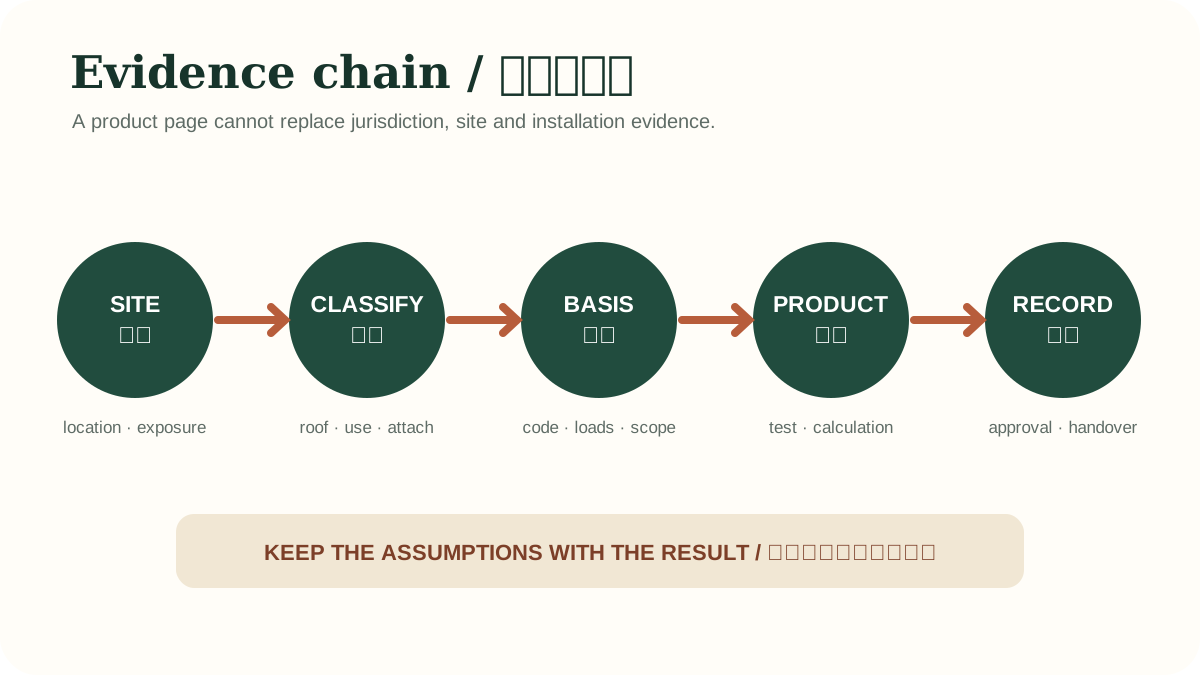
Read a detailed text description
Five linked blocks run from project address and site facts to legal classification, adopted design basis, product-specific evidence and final approval or inspection records. Feedback arrows show that a mismatch in configuration, location or assumptions must be resolved rather than skipped by relying on a generic certificate.
Key takeaways
- Use the national annex for nationally determined parameters.View claim record ·
PWC-EUROCODES-1 - EN 1991 addresses actions; material Eurocodes address resistance.View claim record ·
PWC-EUROCODES-2 - Planning permission is separate from structural compliance.View claim record ·
PWC-EUROCODES-3
The claim register connects stable IDs, article locations and article-level associated sources; it is not an external fact-check of each statement.
On this page
Design framework
EN 1990 sets basis-of-design principles, while EN 1991 covers actions such as self-weight, imposed, snow and wind. Material-specific standards, execution rules and national annexes complete the calculation framework.
Project evidence
A product brochure or CE-related statement does not automatically demonstrate site-specific structural adequacy. The project still needs the correct geometry, actions, foundations, connections and national requirements.
European framework for actions including self-weight, imposed, snow and wind actions.
Use the Eurocodes as a coordinated set
EN 1990 establishes the basis, EN 1991 provides actions, material Eurocodes address resistance and serviceability, and geotechnical or seismic Eurocodes may also apply. National Annexes contain nationally determined parameters. Selecting one material clause without the action, combination, execution and national context is incomplete.
Manage the second-generation transition
Eurocode editions are evolving, while national publication, withdrawal of older standards and Annex availability occur on different schedules. The project basis should list every part and National Annex used, amendment status and execution standard. Do not mix parameters from generations unless the responsible designer has established compatibility.
European framework covering resistance, serviceability, durability and fire resistance of structural aluminium.
Separate the CEN timetable from your project's applicable edition
The European Commission's programme page states that the second-generation family will include 11 European Standards and 2 Technical Specifications, in total 74 parts, and that CEN makes the parts available to the National Standards Bodies after all Enquiries and Formal Votes close, with a latest Date of Availability no later than 30 March 2026. That date describes when a standard reaches national standards bodies, not when it applies to a project. The page defines the Date of Publication as the latest date by which each EN has to be implemented at national level by publishing an identical national standard or by endorsement, and National Annexes with nationally determined parameters are prepared nationally afterwards. A supplier statement that a product is “Eurocode compliant”, or a design note quoting an EN number without an edition, therefore does not identify the applicable edition. Read the CEN documents as programme information and confirm the applicable part, edition and National Annex with the authority and the responsible designer for the actual project.
What the second generation changes, and why it reaches a pergola
The Commission's summary of the second-generation changes lists further harmonisation and improved ease of use for day-to-day calculation, requirements for the assessment, re-use and retrofitting of existing structures, strengthened robustness requirements, a new Eurocode on structural glass, and pre-normative work on fibre-polymer composite (FRP) and tensioned membrane structures with related CEN Technical Specifications. Those programme-level directions are relevant to ordinary pergola work rather than only to large buildings. Adding glazing, heavier roofing, screens or a heating or photovoltaic assembly to an existing frame is an assessment-and-retrofit question about an existing structure. A glass canopy or a fabric, FRP or tensioned-membrane product sits in the areas whose framework is being extended. Robustness provisions address what happens after a local member, connection or support is damaged. None of this converts the programme pages into an applicable edition, a capacity, a product rating or an approval.
Expert-prepared implementation material for Eurocode 5 timber design, hosted by the European Commission JRC.
Keep the design basis readable across the transition
Record one line per part used: the standard and part number, the generation and edition, the National Annex and its nationally determined parameters, the amendment and consolidation status, the execution standard, and the date the status was checked. Mark which parts of the current design basis are still first generation, and treat any attempt to combine values from different generations as an open question for the responsible designer rather than a routine substitution. Where a product, calculation or approval document cites an EN number, ask for the edition, the National Annex and the amendments it was actually assessed against. This article cannot determine whether a first- or second-generation edition is in force for a project, whether a National Annex has been published, or what verification or approval a particular structure needs.
Evidence check before acting
This article provides general educational synthesis; these three checks turn reading into project-specific verification work.
| Confirm | Stronger evidence to retain | What this article cannot establish |
|---|---|---|
| Jurisdiction, adopted edition, local amendments, use, site constraints and permit pathway | Written authority guidance, current adopted text and project permit documents | A model code, national guide or neighboring approval does not establish local permission. |
Compare approval-verification pathways in other jurisdictions
Cross-jurisdiction comparison helps identify questions to ask; it does not transfer an exemption, code or approval outcome from one location to another.
Registered cited sources and scope
European framework for actions including self-weight, imposed, snow and wind actions.
European framework covering resistance, serviceability, durability and fire resistance of structural aluminium.
Expert-prepared implementation material for Eurocode 5 timber design, hosted by the European Commission JRC.
Official European Commission programme page for the second generation of the EN Eurocodes. It states that the family will include 11 European Standards and 2 Technical Specifications, in total 74 parts; that CEN makes each part available to the National Standards Bodies after the closure of all Enquiries and Formal Votes, with the latest Date of Availability (DAV) no later than 30 March 2026; and that the Date of Publication is the latest date by which each EN has to be implemented at national level by publishing an identical national standard or by endorsement. It describes the programme timetable and its terminology only: it does not state which edition applies to a project, whether a National Annex exists or what it contains, or any design value, capacity, product performance or approval outcome.
Official European Commission page summarising the second-generation changes prepared by CEN/TC 250 subcommittees: further harmonisation and improved ease of use for day-to-day calculation; requirements for the assessment, re-use and retrofitting of existing structures; strengthened robustness requirements; a new Eurocode on structural glass; and pre-normative work on fibre-polymer composite (FRP) and tensioned membrane structures with related CEN Technical Specifications. It summarises programme-level changes: it does not establish an applicable edition, a National Annex, a design value, a product rating or a project approval.
Cite this page
Pergola Wiki Editorial Team. “Eurocodes and European projects.” Pergola Wiki. Content version 1.7.34; editorially reviewed 24 Sept 2026. https://pergola.wiki/articles/eurocodes/