Who created this, how it was made and why it exists
- Who
- Published under the organizational identity Pergola Wiki Editorial Team; neither AI nor the organization is presented as a named professional individual.
- How
- AI assistance was used for drafting, translation, source-metadata organization, static-site coding and automated QA in a publisher-directed workflow. Automated checks do not establish technical correctness.
- Why
- To provide free bilingual educational synthesis; one disclosed Oscar Pergola industry link does not determine conclusions, source tiers or rankings.
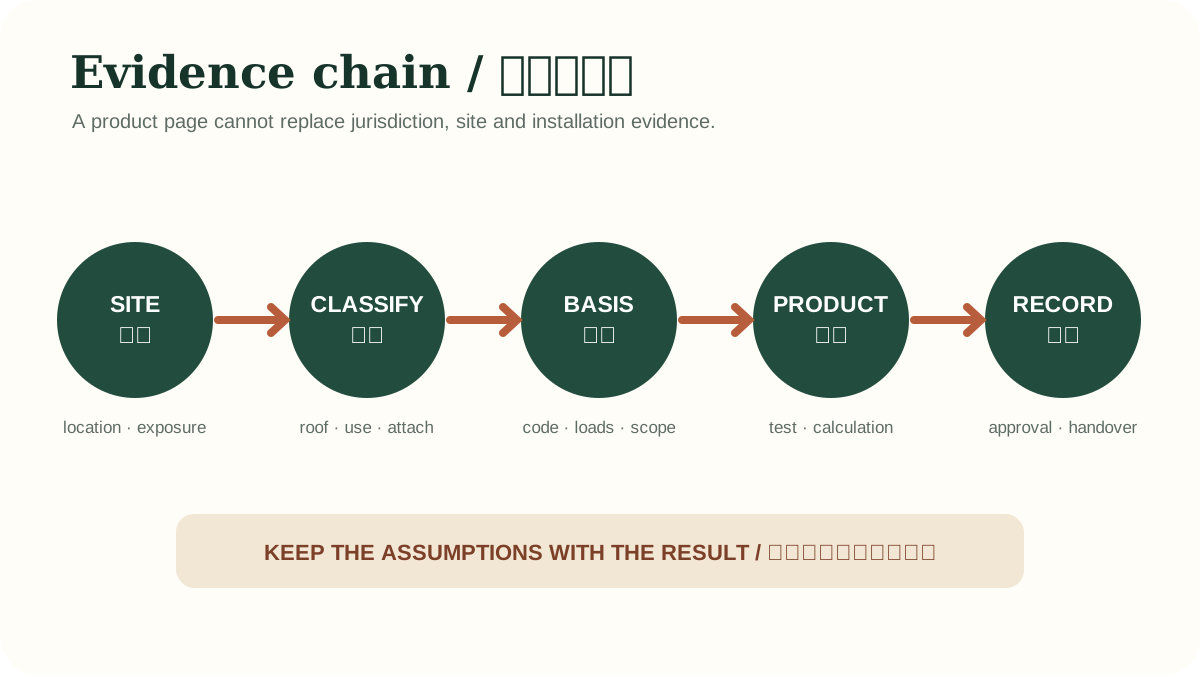
Read a detailed text description
Five linked blocks run from project address and site facts to legal classification, adopted design basis, product-specific evidence and final approval or inspection records. Feedback arrows show that a mismatch in configuration, location or assumptions must be resolved rather than skipped by relying on a generic certificate.
Key takeaways
- EN 13561 product evidence and EU wind classes can describe a pergola awning; they do not establish the supporting structure, anchorage or complete project.View claim record ·
PWC-EU-PERGOLA-AWNING-EN-13561-WIND-CLASSES-1 - The official classes are pressure classes, not direct allowable wind-speed labels; retain the declared value, configuration, test or calculation basis and operating state.View claim record ·
PWC-EU-PERGOLA-AWNING-EN-13561-WIND-CLASSES-2 - DoP and CE checks belong beside—never instead of—site actions, local rules, installation instructions and authority or professional review.View claim record ·
PWC-EU-PERGOLA-AWNING-EN-13561-WIND-CLASSES-3
New or rewritten sections in this topic use section-mapped citations; the claim register remains editorial synthesis, not external fact-checking or independent review.
On this page
- First identify the product being claimed
- Keep the EU instruments and editions separate
- Read the class as pressure, not weather-app wind speed
- Match the exact assessed configuration
- Understand what DoP and CE do
- Verify the supporting structure and anchorage separately
- Treat CPR and standards status as a dated dual-regime check
- Build a project evidence chain
First identify the product being claimed
Pergola awning is a product-family term within the external-blind and awning framework; it is not automatically every structure marketed as a pergola. Record the manufacturer, model, dimensions, fabric and lateral guidance, operating state, installation instructions and the exact normative reference. DIN’s public EN 13561 metadata distinguishes the awning from the supporting structure to which it is fixed.
Public standards metadata identifying pergola awnings within EN 13561 and distinguishing the product from the supporting structure to which it is fixed. The copyrighted standard text is not reproduced.
Keep the EU instruments and editions separate
Commission Delegated Regulation (EU) 2019/1188 establishes wind-load performance classes and explicitly differentiates pergola awnings. DIN’s current catalogue describes EN 13561:2015 product scope, while Implementing Decision (EU) 2023/1586 cites EN 13561:2015 + AC:2016 in the Machinery Directive system. By contrast, the Commission’s CPR summary generated on 9 February 2026 still lists EN 13561:2004+A1:2008. These records answer different legal and technical questions and must not be merged into one claim that the 2015 edition is the current CPR harmonised version.
Binding EU delegated regulation establishing wind-load performance classes and explicitly distinguishing pergola awnings. Product classes do not establish site wind speed, supporting-structure capacity, anchorage or project approval.
Public standards metadata identifying pergola awnings within EN 13561 and distinguishing the product from the supporting structure to which it is fixed. The copyrighted standard text is not reproduced.
Official EU decision used to verify the cited EN 13561:2015 + AC:2016 reference in the applicable harmonised-standards list. A listing must still be checked for current status, product scope and applicable legislation.
Commission summary showing EN 13561:2004+A1:2008 in the CPR harmonised-standards list as generated on 9 February 2026. The summary consolidates Official Journal references for information and does not itself create legal effects; the applicable OJ record and transition period still require a dated check.
Read the class as pressure, not weather-app wind speed
Classes 0–6 are defined by nominal pressure pN, with safety pressure at 1.2 times the nominal boundary. Pressure on an installed product depends on aerodynamic assumptions, geometry, exposure and test or calculation scope. Do not convert a class directly into a universal allowable wind speed or assume the highest class has unlimited capacity.
Binding EU delegated regulation establishing wind-load performance classes and explicitly distinguishing pergola awnings. Product classes do not establish site wind speed, supporting-structure capacity, anchorage or project approval.
Match the exact assessed configuration
A useful declaration identifies the product, model, dimensions, fabric or cover, guides, fasteners, operating state, normative document and assessment route. A result for one bay, projection or support arrangement does not automatically transfer to a larger unit, different fabric, added screen or altered installation. Resolve every mismatch instead of averaging or selecting the most favorable document.
Public standards metadata identifying pergola awnings within EN 13561 and distinguishing the product from the supporting structure to which it is fixed. The copyrighted standard text is not reproduced.
Binding EU delegated regulation establishing wind-load performance classes and explicitly distinguishing pergola awnings. Product classes do not establish site wind speed, supporting-structure capacity, anchorage or project approval.
Understand what DoP and CE do
Under the applicable Construction Products Regulation route, a Declaration of Performance and CE marking communicate assessed product performance where the legal and harmonised-standard conditions require them. They are market-information instruments—not quality awards, structural calculations, installation certificates, planning permission, approval by the European Union or proof that the complete project meets local requirements.
Commission summary showing EN 13561:2004+A1:2008 in the CPR harmonised-standards list as generated on 9 February 2026. The summary consolidates Official Journal references for information and does not itself create legal effects; the applicable OJ record and transition period still require a dated check.
New Construction Products Regulation framework for placing covered construction products on the EU market. Marketing, declaration and CE-marking duties do not replace project design, installation verification, local requirements or authority approval.
Current Commission entry point for the new and previous CPR, working plan, national product contact points, Declaration of Performance and notified-body information. It is a navigation source, not a project-compliance decision.
Verify the supporting structure and anchorage separately
Trace load from fabric or moving cover through rails, brackets, beams, posts, base plates, anchors, substrate, foundations and soil—or into an existing building. The awning product class does not verify those components unless they are explicitly inside the assessed scope. Added screens, enclosure or a changed operating state can alter actions and must trigger a new check.
Public standards metadata identifying pergola awnings within EN 13561 and distinguishing the product from the supporting structure to which it is fixed. The copyrighted standard text is not reproduced.
Binding EU delegated regulation establishing wind-load performance classes and explicitly distinguishing pergola awnings. Product classes do not establish site wind speed, supporting-structure capacity, anchorage or project approval.
Treat CPR and standards status as a dated dual-regime check
Regulation (EU) 2024/3110 introduces a new CPR framework with transition provisions rather than making every prior route disappear on one date. The Commission portal and its 9 February 2026 informational summary must be read with the controlling Official Journal references. Check the applicable CPR regime, harmonised-standard edition, machinery requirements, product family, country and date separately. This page records an editorial check on 30 July 2026, not permanent legal advice.
Official EU decision used to verify the cited EN 13561:2015 + AC:2016 reference in the applicable harmonised-standards list. A listing must still be checked for current status, product scope and applicable legislation.
Commission summary showing EN 13561:2004+A1:2008 in the CPR harmonised-standards list as generated on 9 February 2026. The summary consolidates Official Journal references for information and does not itself create legal effects; the applicable OJ record and transition period still require a dated check.
New Construction Products Regulation framework for placing covered construction products on the EU market. Marketing, declaration and CE-marking duties do not replace project design, installation verification, local requirements or authority approval.
Current Commission entry point for the new and previous CPR, working plan, national product contact points, Declaration of Performance and notified-body information. It is a navigation source, not a project-compliance decision.
Build a project evidence chain
Retain the official standard and regulation references, current DoP, CE information, product identity, configuration, declared class and pressure, assessment report, installation instructions, support and anchorage design, local requirements, inspection and commissioning record. Stop when identities, editions, scopes or installed conditions conflict; an incomplete chain cannot be repaired by repeating the class label.
Binding EU delegated regulation establishing wind-load performance classes and explicitly distinguishing pergola awnings. Product classes do not establish site wind speed, supporting-structure capacity, anchorage or project approval.
Current Commission entry point for the new and previous CPR, working plan, national product contact points, Declaration of Performance and notified-body information. It is a navigation source, not a project-compliance decision.
Official EU nominal- and safety-pressure class reference
These pressure bands reproduce Regulation (EU) 2019/1188. They are not site wind-speed ratings and do not verify supporting structure or anchorage.
| Checkpoint | Define | Retain |
|---|---|---|
| Class 0 | Nominal pressure < 40 N/m²; safety pressure < 48 N/m² | Class 0 is still a declared performance class; it is not a site wind-speed rating or proof of project suitability. |
| Class 1 | Nominal pressure ≥ 40 and < 70 N/m²; safety pressure ≥ 48 and < 84 N/m² | Match the exact product, size, configuration, test or calculation basis and declaration. |
| Class 2 | Nominal pressure ≥ 70 and < 110 N/m²; safety pressure ≥ 84 and < 132 N/m² | Do not convert the class directly into an allowable weather-app wind speed. |
| Class 3 | Nominal pressure ≥ 110 and < 170 N/m²; safety pressure ≥ 132 and < 204 N/m² | The class does not establish the supporting frame, anchorage, substrate or foundation capacity. |
| Class 4 | Nominal pressure ≥ 170 and < 270 N/m²; safety pressure ≥ 204 and < 324 N/m² | Check the operating state, installed dimensions, lateral guides and every excluded configuration. |
| Class 5 | Nominal pressure ≥ 270 and < 400 N/m²; safety pressure ≥ 324 and < 480 N/m² | Product performance information does not replace site design actions, local rules or installation verification. |
| Class 6 | Nominal pressure ≥ 400 N/m²; safety pressure ≥ 480 N/m² | No upper bound is stated by the class label; use the declared value and scope rather than assuming unlimited resistance. |
Evidence check before acting
This article provides general educational synthesis; these three checks turn reading into project-specific verification work.
| Confirm | Stronger evidence to retain | What this article cannot establish |
|---|---|---|
| Jurisdiction, adopted edition, local amendments, use, site constraints and permit pathway | Written authority guidance, current adopted text and project permit documents | A model code, national guide or neighboring approval does not establish local permission. |
Compare approval-verification pathways in other jurisdictions
Cross-jurisdiction comparison helps identify questions to ask; it does not transfer an exemption, code or approval outcome from one location to another.
Registered cited sources and scope
Public standards metadata identifying pergola awnings within EN 13561 and distinguishing the product from the supporting structure to which it is fixed. The copyrighted standard text is not reproduced.
Binding EU delegated regulation establishing wind-load performance classes and explicitly distinguishing pergola awnings. Product classes do not establish site wind speed, supporting-structure capacity, anchorage or project approval.
Official EU decision used to verify the cited EN 13561:2015 + AC:2016 reference in the applicable harmonised-standards list. A listing must still be checked for current status, product scope and applicable legislation.
Commission summary showing EN 13561:2004+A1:2008 in the CPR harmonised-standards list as generated on 9 February 2026. The summary consolidates Official Journal references for information and does not itself create legal effects; the applicable OJ record and transition period still require a dated check.
New Construction Products Regulation framework for placing covered construction products on the EU market. Marketing, declaration and CE-marking duties do not replace project design, installation verification, local requirements or authority approval.
Current Commission entry point for the new and previous CPR, working plan, national product contact points, Declaration of Performance and notified-body information. It is a navigation source, not a project-compliance decision.
Cite this page
Pergola Wiki Editorial Team. “EU pergola awnings: wind classes, CPR and CE limits.” Pergola Wiki. Content version 1.7.1; editorially reviewed 30 Jul 2026. https://pergola.wiki/articles/eu-pergola-awning-en-13561-wind-classes/