Who created this, how it was made and why it exists
- Who
- Published under the organizational identity Pergola Wiki Editorial Team; neither AI nor the organization is presented as a named professional individual.
- How
- AI assistance was used for drafting, translation, source-metadata organization, static-site coding and automated QA in a publisher-directed workflow. Automated checks do not establish technical correctness.
- Why
- To provide free bilingual educational synthesis; one disclosed Oscar Pergola industry link does not determine conclusions, source tiers or rankings.
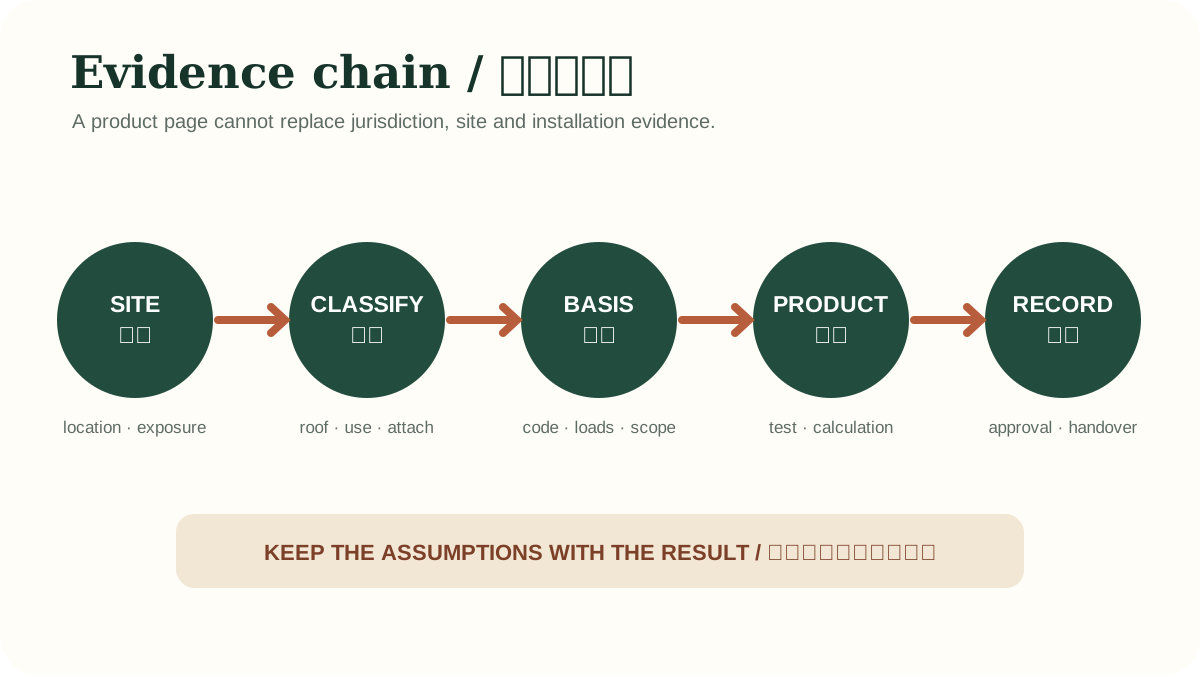
Read a detailed text description
Five linked blocks run from project address and site facts to legal classification, adopted design basis, product-specific evidence and final approval or inspection records. Feedback arrows show that a mismatch in configuration, location or assumptions must be resolved rather than skipped by relying on a generic certificate.
Key takeaways
- Do not infer one Australia-wide NCC 2025 adoption date; confirm the state or territory rule and application date.View claim record ·
PWC-AUSTRALIA-NCC-1 - “Pergola” may mean an unroofed structure in a specific NCC context; roofing can change classification.View claim record ·
PWC-AUSTRALIA-NCC-2 - Planning, site hazards and project-specific evidence remain separate from the national code entry point.View claim record ·
PWC-AUSTRALIA-NCC-3
The claim register connects stable IDs, article locations and article-level associated sources; it is not an external fact-check of each statement.
On this page
Classification first
NCC explanatory material shows why terminology matters: an unroofed pergola can be treated differently from a roofed patio or verandah. The actual design and use, not the marketing name, determine the pathway.
Regional variation
State and territory schedules, planning schemes, bushfire attack levels, wind regions and local siting rules can add requirements. Consult the relevant building surveyor or authority before construction.
Official Class 1 and 10 reference retained for jurisdictions or applications still using NCC 2022 Amendment 2. It is not evidence that the edition remains applicable to every Australian project during the NCC 2025 transition.
Treat NCC 2025 as eight jurisdiction decisions, not one national switch
Official pages checked on 3 August 2026 show materially different positions. Victoria, Western Australia and Tasmania commenced or adopted NCC 2025 on 1 May 2026. New South Wales and Queensland set 1 May 2027; the ACT also sets 1 May 2027 with a stated transition from 1 May 2026. South Australia separates its Building Code date of 1 May 2027 from Plumbing Code adoption on 1 May 2026. The Northern Territory retained NCC 2022 and existing variations. Record the jurisdiction, application or approval date, code volume and local transition instead of transferring one date across Australia.
NCC compliance starts with classification and jurisdiction
The NCC is adopted through state and territory law, with variations and administrative processes outside the technical text. Identify whether the work is an appurtenant structure, roofed outdoor area or another classification, then confirm planning, building approval, bushfire, cyclone, termite and pool-barrier implications.
A jurisdiction-specific example showing that “pergola” may mean an unroofed structure.
Site hazard changes the evidence needed
Wind region and terrain, bushfire attack level, coastal exposure, soil movement and proximity to boundaries can change materials and detailing. A supplier drawing prepared for a different region is not project verification. Record the site parameters, engineering basis, product evidence and inspection responsibility in one coordinated package.
NCC 2025 jurisdiction adoption matrix
Read the date together with the code volume, transition boundary and official jurisdiction source; this table is a dated navigation aid, not a project ruling.
| Checkpoint | Define | Retain |
|---|---|---|
| New South Wales | NCC 2025 adoption scheduled; 2027-05-01 | NCC 2022 Amendment 2 remains the building-code baseline until the scheduled adoption; NSW variations still apply. |
| Victoria | NCC 2025 adopted; 2026-05-01 | The official page describes a design-progress transition; the responsible building surveyor must determine the edition for a project. |
| Queensland | NCC 2025 commencement delayed; 2027-05-01 | The official notice states NCC 2022 remains in force until 30 April 2027. |
| South Australia | Building and plumbing adoption dates differ; Building Code: 2027-05-01; Plumbing Code: 2026-05-01 | NCC 2022 Amendment 2 remains the Building Code through 30 April 2027; the Plumbing Code within NCC 2025 has already been adopted. |
| Western Australia | NCC 2025 adopted with WA variations; 2026-05-01 | The cited answer confirms adoption but does not enumerate every state variation or project transition. |
| Tasmania | NCC 2025 commenced; 2026-05-01 | The regulator notice confirms commencement; Tasmanian variations, determinations and project transitions still require separate checks. |
| Australian Capital Territory | NCC 2025 adoption scheduled with transition; Transition: 2026-05-01; mandatory adoption: 2027-05-01 | During the stated transition, eligible new approvals may use NCC 2022 or NCC 2025; project eligibility must be confirmed. |
| Northern Territory | NCC 2025 not adopted from the national availability date; 2026-05-01 | The Territory retained NCC 2022 and existing variations; future legal changes require a fresh check. |
Evidence check before acting
This article provides general educational synthesis; these three checks turn reading into project-specific verification work.
| Confirm | Stronger evidence to retain | What this article cannot establish |
|---|---|---|
| Jurisdiction, adopted edition, local amendments, use, site constraints and permit pathway | Written authority guidance, current adopted text and project permit documents | A model code, national guide or neighboring approval does not establish local permission. |
Compare approval-verification pathways in other jurisdictions
Cross-jurisdiction comparison helps identify questions to ask; it does not transfer an exemption, code or approval outcome from one location to another.
Registered cited sources and scope
Official Class 1 and 10 reference retained for jurisdictions or applications still using NCC 2022 Amendment 2. It is not evidence that the edition remains applicable to every Australian project during the NCC 2025 transition.
A jurisdiction-specific example showing that “pergola” may mean an unroofed structure.
Official abstract for corrosivity categories affecting steel coating selection.
Official national entry point stating that jurisdictions may consider NCC 2025 adoption from 1 May 2026 and must set their own adoption timeline. It does not establish the edition applicable to a particular address or approval application.
Official New South Wales page stating that NSW will adopt NCC 2025 on 1 May 2027 and that NSW-specific variations still apply. This is evidence for NSW only, not an Australia-wide adoption date.
Official Victorian page stating that Victoria adopted NCC 2025 on 1 May 2026 and describing a design-progress transition. It applies only to Victoria and does not determine the edition for a specific permit or project.
Official Queensland notice stating that NCC 2025 commencement is delayed to 1 May 2027 and NCC 2022 remains in force until then. It is general information and does not replace legislation or project advice.
Official South Australian page distinguishing Building Code adoption on 1 May 2027 from Plumbing Code adoption on 1 May 2026. The split must not be collapsed into one whole-of-NCC date.
Official parliamentary answer stating that Western Australia adopted NCC 2025 on 1 May 2026 with a small number of WA variations. It does not enumerate every variation or project transition.
Official Tasmanian regulator notice stating that NCC 2025 commenced on 1 May 2026. Project users must still check Tasmanian variations, determinations and transitional provisions.
Official ACT release stating adoption on 1 May 2027 and a transition from 1 May 2026 in which eligible new approvals may use NCC 2022 or NCC 2025. It does not decide eligibility for a specific application.
Official Northern Territory page stating that NCC 2025 did not apply from 1 May 2026 and the Territory retained NCC 2022 with existing variations. Later legal changes still require a fresh check.
Cite this page
Pergola Wiki Editorial Team. “Australian pergolas: NCC adoption transition.” Pergola Wiki. Content version 1.7.3; editorially reviewed 3 Aug 2026. https://pergola.wiki/articles/australia-ncc/