Who created this, how it was made and why it exists
- Who
- Published under the organizational identity Pergola Wiki Editorial Team; neither AI nor the organization is presented as a named professional individual.
- How
- AI assistance was used for drafting, translation, source-metadata organization, static-site coding and automated QA in a publisher-directed workflow. Automated checks do not establish technical correctness.
- Why
- To provide free bilingual educational synthesis; one disclosed Oscar Pergola industry link does not determine conclusions, source tiers or rankings.
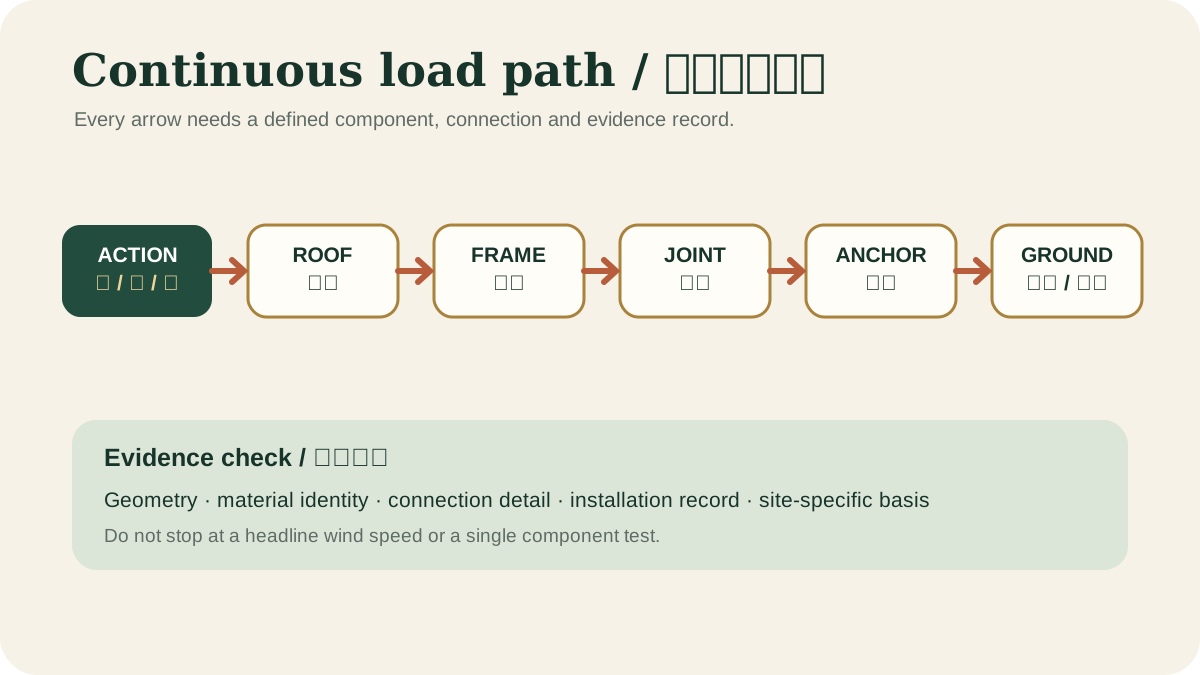
Read a detailed text description
The diagram follows gravity, wind uplift and lateral actions from the roof surface into rafters or louvers, beams and posts. It continues through every connection, base plate and anchor into the foundation and finally the supporting soil, emphasizing that one weak or undocumented link interrupts the claimed structural path.
Key takeaways
- Do not use a temperate-climate specification in snow country.View claim record ·
PWC-SNOW-LOAD-1 - Adjacent roofs can create drifts.View claim record ·
PWC-SNOW-LOAD-2 - Operational snow sensors do not replace structural capacity.View claim record ·
PWC-SNOW-LOAD-3
The claim register connects stable IDs, article locations and article-level associated sources; it is not an external fact-check of each statement.
On this page
Accumulation patterns
Roof shape, thermal conditions, exposure and nearby higher surfaces influence snow depth. Louver pockets, gutters and attached-building interfaces can collect ice or drifted snow.
Use and maintenance
A system that requires louvers to remain open or a canopy to be retracted in snow needs a reliable operating plan. Safe snow removal methods must avoid unbalanced loading and damage to panels or mechanisms.
European framework for actions including self-weight, imposed, snow and wind actions.
Ground snow is not roof snow
Structural provisions transform regional hazard into roof actions using exposure, thermal condition, importance, slope and geometry. Adjacent roofs, parapets and height changes can create drift or sliding concentrations. A generic kilograms-per-square-metre claim is incomplete unless the load definition, distribution, combinations and permitted operating state are identified.
Movable roofs need an explicit snow strategy
Documentation should state whether louvers or fabric remain open, close automatically, or must be cleared before accumulation; it should also address freezing and loss of power. “Open during snow” does not remove snow effects from frames, gutters, motors or partially obstructed blades, and it relies on an operating action that must be realistic and documented.
US model-code provisions for residential patio covers; only applicable where adopted.
Depth is not a universal action threshold
NRC Canada cautions that snow weight, not depth alone, governs and that small accessory buildings may not follow the same code assumptions as larger roofs. Record wetness, drifting, rain-on-snow, refreezing, blocked drainage and the verified project design basis. A weather-app depth, generic conversion or nearby ground observation cannot by itself establish the roof action or remaining capacity.
Treat warning signs as a stop-use decision
FEMA identifies unusual sounds, visible sagging or movement, cracked or split members, severe leaks and water collecting where it should drain as warning signs of possible overstress. For a pergola, keep people out of and away from the affected area, do not operate jammed louvers or add temporary props without a plan, and contact the responsible building authority or a qualified design professional. These are screening and escalation cues, not a remote diagnosis.
Official standard hub for US structural actions including wind, snow, rain, seismic and load combinations.
Snow removal is a separate hazardous operation
OSHA guidance for workplace roof clearing says the structure should be assessed before access and that methods avoiding roof access should be used where possible. Workers, ladders and equipment add load; uneven removal can worsen load concentration; ice, hidden edges, electricity and falling snow add hazards. A project-specific plan must set access, fall protection, sequence, exclusion zones and the person authorized to decide when work is safe.
Treat meltwater as a separate reopening check
Government of Canada flood-prevention guidance links thawing snow and rain with water pooling, eavestroughs, downspouts, foundations and site grading. After a snow or ice event, inspect safely accessible collection paths, outlets, discharge points and surrounding ground before reopening; keep the area closed and escalate persistent ponding, leakage, ice-blocked drainage, displaced parts or electrical water entry. The household depth figures in that guidance are maintenance prompts for homes, not a pergola capacity or reopening threshold.
Official application guides for wind, snow, rain and seismic provisions; guides support but do not replace the standard.
Evidence check before acting
This article provides general educational synthesis; these three checks turn reading into project-specific verification work.
| Confirm | Stronger evidence to retain | What this article cannot establish |
|---|---|---|
| Site actions, continuous load path, foundations, connections and supporting structure | Project-specific site data, calculations, approved drawings and inspection records | A general table, calculator or article is not a project design or approval. |
Registered cited sources and scope
European framework for actions including self-weight, imposed, snow and wind actions.
US model-code provisions for residential patio covers; only applicable where adopted.
Official standard hub for US structural actions including wind, snow, rain, seismic and load combinations.
Official application guides for wind, snow, rain and seismic provisions; guides support but do not replace the standard.
Government guidance on pre-season assessment, snow-event monitoring, warning signs, escalation and safer snow-removal planning. It addresses buildings generally and does not establish a pergola-specific capacity or removal threshold.
Official workplace guidance requiring snow-removal hazard planning, structural access assessment and preference for methods that avoid roof access where possible. It is an occupational-safety source, not a residential operating instruction or structural calculation.
Official public guidance distinguishing snow weight from snow depth, listing stress indicators and noting that code treatment can differ for small accessory buildings. It does not determine the adopted code, capacity or safe action for a specific pergola.
Official household flood-prevention guidance connecting snowmelt, rain, eavestroughs, downspouts, grading and water pooling. Its household maintenance depths are not a pergola structural-capacity, reopening or snow-removal threshold.
Cite this page
Pergola Wiki Editorial Team. “Snow and ice actions.” Pergola Wiki. Content version 1.7.6; editorially reviewed 6 Aug 2026. https://pergola.wiki/articles/snow-load/