Who created this, how it was made and why it exists
- Who
- Published under the organizational identity Pergola Wiki Editorial Team; neither AI nor the organization is presented as a named professional individual.
- How
- AI assistance was used for drafting, translation, source-metadata organization, static-site coding and automated QA in a publisher-directed workflow. Automated checks do not establish technical correctness.
- Why
- To provide free bilingual educational synthesis; one disclosed Oscar Pergola industry link does not determine conclusions, source tiers or rankings.
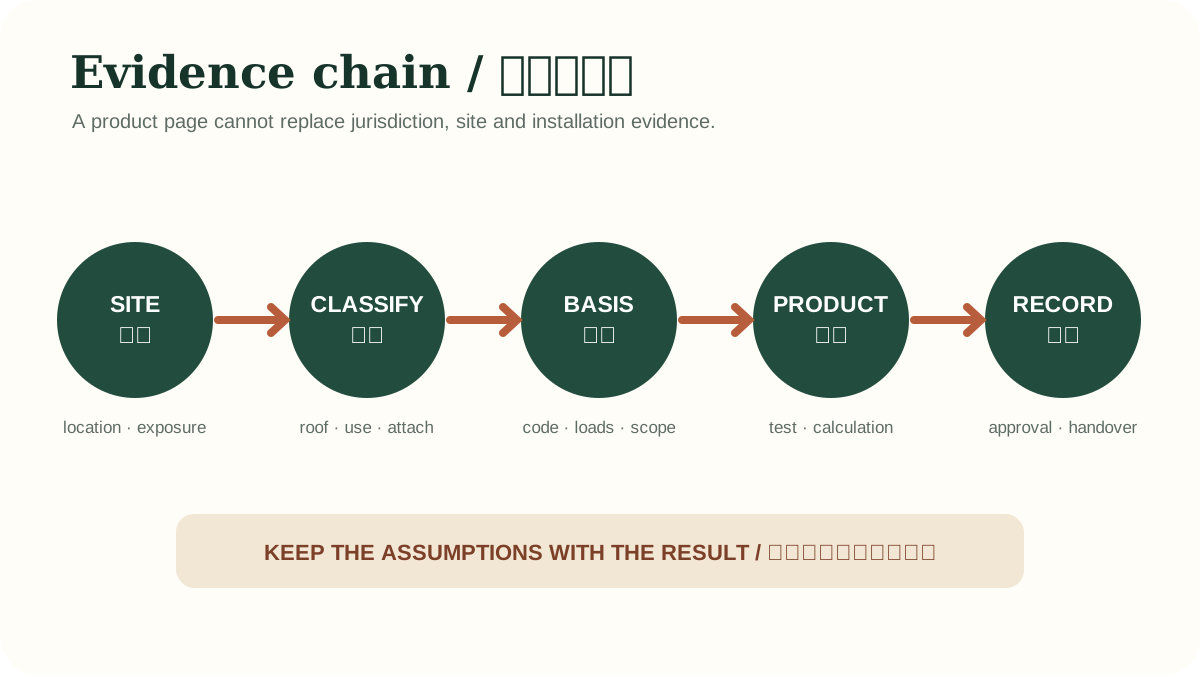
Read a detailed text description
Five linked blocks run from project address and site facts to legal classification, adopted design basis, product-specific evidence and final approval or inspection records. Feedback arrows show that a mismatch in configuration, location or assumptions must be resolved rather than skipped by relying on a generic certificate.
Key takeaways
- Receiving a complaint or a letter is not the same as being ordered to remove a structure; the authority has to decide whether enforcement action is expedient, and the cited guidance lists options that include no formal action.View claim record ·
PWC-ENGLAND-PERGOLA-ENFORCEMENT-1 - In England, section 171B of the Town and Country Planning Act 1990 sets ten years from substantial completion for operational development completed on or after 25 April 2024, with four years retained for earlier cases, while the same section keeps four years for Wales.View claim record ·
PWC-ENGLAND-PERGOLA-ENFORCEMENT-2 - A retrospective application and a ground (a) enforcement appeal reach one permission decision between them, so what the authority does and in which order changes what remains available.View claim record ·
PWC-ENGLAND-PERGOLA-ENFORCEMENT-3
New or rewritten sections in this topic use section-mapped citations; the claim register remains editorial synthesis, not external fact-checking or independent review.
On this page
- Direct answer: enforcement is a discretionary decision, not an automatic removal order
- What the statutory time limits actually measure
- Options short of a formal notice
- The formal tools, and why the appeal route differs
- Retrospective application or ground (a) appeal: one opportunity, two routes
- Assemble the facts before you respond
- England pergola enforcement FAQ
Direct answer: enforcement is a discretionary decision, not an automatic removal order
A local planning authority (LPA) that receives a complaint must decide what, if anything, to do about it. England's Planning Practice Guidance on enforcement and post-permission matters lists the proportionate options an authority may consider: no formal action, inviting a retrospective planning application and issuing an enforcement warning notice, serving a planning contravention notice, an enforcement notice, a planning enforcement order, a stop notice, a temporary stop notice, a breach of condition notice or seeking an injunction. What an authority can ultimately require depends on facts it has to establish, including what was built, when it was substantially completed, whether permission was needed or granted, and whether the development has become immune from enforcement. A letter from a council is the start of that assessment, not its conclusion.
England planning-practice guidance on enforcement. It sets out the section 171B Town and Country Planning Act 1990 time limits as amended, including the transitional arrangements for operational development substantially completed before 25 April 2024; the proportionate options a local planning authority may consider (no formal action, retrospective application, enforcement warning notice, planning contravention notice, enforcement notice, planning enforcement order, stop notice, temporary stop notice, breach of condition notice, injunction, and others); the statement that a person who has undertaken unauthorised development has only one opportunity to obtain permission after the event, through a section 73A application or a ground (a) appeal; and the limits on that choice in sections 70C and 174. It is departmental practice guidance for England, not legislation, not a decision about any project and not a rule for Wales, Scotland or Northern Ireland.
What the statutory time limits actually measure
In most cases development becomes immune from enforcement when no action is taken within the statutory period in section 171B of the Town and Country Planning Act 1990. For a breach consisting of building, engineering, mining or other operations, the section now provides ten years from substantial completion in England and four years in Wales. The ten-year period applies where substantial completion took place on or after 25 April 2024; the guidance records four years for earlier cases under the transitional arrangements. For an unauthorised change of use of a building to use as a single dwellinghouse the same England and Wales split applies to the date of the change, and other breaches of planning control — essentially other changes of use — are subject to ten years. Two situations can extend exposure beyond those dates. First, further enforcement action is possible within four years of earlier action, or purported action, on the same breach. Second, in cases of deliberate concealment the courts have found that the time limits do not engage until the breach is discovered, and an authority may serve a notice out of time or apply for a planning enforcement order. The limits measure the breach, not how long you have owned the property, and immunity from enforcement is neither a grant of planning permission nor a substitute for building regulations, listed building consent, covenants or other controls.
Revised statutory text of section 171B. For a breach consisting of building, engineering, mining or other operations, no enforcement action may be taken after ten years from substantial completion in England and after four years in Wales; the same England and Wales split applies to an unauthorised change of use of a building to use as a single dwellinghouse; any other breach of planning control is subject to ten years; and further enforcement action remains possible within four years of earlier action or purported action on the same breach. It states time limits only: it does not decide whether a structure needed permission, whether it is lawful, or what steps an authority will require.
England planning-practice guidance on enforcement. It sets out the section 171B Town and Country Planning Act 1990 time limits as amended, including the transitional arrangements for operational development substantially completed before 25 April 2024; the proportionate options a local planning authority may consider (no formal action, retrospective application, enforcement warning notice, planning contravention notice, enforcement notice, planning enforcement order, stop notice, temporary stop notice, breach of condition notice, injunction, and others); the statement that a person who has undertaken unauthorised development has only one opportunity to obtain permission after the event, through a section 73A application or a ground (a) appeal; and the limits on that choice in sections 70C and 174. It is departmental practice guidance for England, not legislation, not a decision about any project and not a rule for Wales, Scotland or Northern Ireland.
Options short of a formal notice
Several routes stop short of compulsion. An authority may conclude that no formal action is appropriate. It can invite a retrospective application under section 73A where an application is the sensible way to regularise the situation, and an enforcement warning notice under section 172ZA formalises that invitation: it sets out the matters that appear to be a breach of planning control and states that further enforcement action may be taken unless an application is made by a specified date. To establish the facts, an authority can serve a planning contravention notice under section 171C, which can require information about operations, uses and activities on the land and can invite a constructive response about how a suspected breach might be remedied. An invitation is not a decision. The guidance states that permission cannot be assumed from the invitation and that the authority must not fetter its discretion before determining the application in the normal way.
England planning-practice guidance on enforcement. It sets out the section 171B Town and Country Planning Act 1990 time limits as amended, including the transitional arrangements for operational development substantially completed before 25 April 2024; the proportionate options a local planning authority may consider (no formal action, retrospective application, enforcement warning notice, planning contravention notice, enforcement notice, planning enforcement order, stop notice, temporary stop notice, breach of condition notice, injunction, and others); the statement that a person who has undertaken unauthorised development has only one opportunity to obtain permission after the event, through a section 73A application or a ground (a) appeal; and the limits on that choice in sections 70C and 174. It is departmental practice guidance for England, not legislation, not a decision about any project and not a rule for Wales, Scotland or Northern Ireland.
England-focused planning guidance; listed buildings and local constraints can change the answer.
The formal tools, and why the appeal route differs
An enforcement notice is the principal compulsory instrument and can require steps to remedy the breach, which may include altering or removing the structure. A stop notice is a different tool with a different consequence: it can prohibit any or all of the activities comprising the breach specified in a related enforcement notice, cannot be served independently of one, and its effective date must normally be no less than three and no later than 28 days after service. There is no right of appeal to the Secretary of State against the prohibitions in a stop notice, so its validity and the propriety of the decision are challenged by judicial review in the High Court. A temporary stop notice under section 171E requires an activity that breaches planning control to stop immediately, must state the activity to cease and that a person contravening it may be prosecuted, and is used where rapid action is expedient. A breach of condition notice under section 187A requires compliance with a planning condition, and an injunction is available in appropriate cases. Before calculating any deadline, identify exactly which instrument has been served: the routes, periods and consequences are not interchangeable.
England planning-practice guidance on enforcement. It sets out the section 171B Town and Country Planning Act 1990 time limits as amended, including the transitional arrangements for operational development substantially completed before 25 April 2024; the proportionate options a local planning authority may consider (no formal action, retrospective application, enforcement warning notice, planning contravention notice, enforcement notice, planning enforcement order, stop notice, temporary stop notice, breach of condition notice, injunction, and others); the statement that a person who has undertaken unauthorised development has only one opportunity to obtain permission after the event, through a section 73A application or a ground (a) appeal; and the limits on that choice in sections 70C and 174. It is departmental practice guidance for England, not legislation, not a decision about any project and not a rule for Wales, Scotland or Northern Ireland.
Official England guide to enforcement-notice appeals: who may appeal (a person who owns, rents or lawfully occupies the property or land), the rule that the appeal must be received before the date the notice takes effect, submission to the Planning Inspectorate with a copy of the appeal and supporting documents to the local planning authority, the document and file-type requirements, the absence of an appeal fee unless planning permission is also sought, the ability of anyone to comment on an appeal, awards of costs, and the High Court route where a legal mistake is alleged. It describes the appeal process only and does not assess any project, notice or ground of appeal.
Retrospective application or ground (a) appeal: one opportunity, two routes
For unauthorised development, the guidance states that a person has only one opportunity to obtain planning permission after the event. That opportunity is either a retrospective application under section 73A or an appeal against the enforcement notice on the ground that planning permission ought to be granted, known as a ground (a) appeal. The two are alternatives rather than two chances, and the sequence matters. An authority can decline to determine a retrospective application if an enforcement notice has previously been issued, and where an authority decides to issue an enforcement notice after a related application has been made, a ground (a) appeal cannot be made in the circumstances set out in section 174. GOV.UK's enforcement-appeal guide adds that the appeal must be received before the date the notice takes effect, that the appeal is made to the Planning Inspectorate with a copy of the appeal and supporting documents sent to the authority, and that there is no fee to appeal unless planning permission is also being sought. Anyone may comment on an appeal, and a challenge to the inspector's decision is made in the High Court on an alleged legal mistake rather than by re-arguing the planning merits.
England planning-practice guidance on enforcement. It sets out the section 171B Town and Country Planning Act 1990 time limits as amended, including the transitional arrangements for operational development substantially completed before 25 April 2024; the proportionate options a local planning authority may consider (no formal action, retrospective application, enforcement warning notice, planning contravention notice, enforcement notice, planning enforcement order, stop notice, temporary stop notice, breach of condition notice, injunction, and others); the statement that a person who has undertaken unauthorised development has only one opportunity to obtain permission after the event, through a section 73A application or a ground (a) appeal; and the limits on that choice in sections 70C and 174. It is departmental practice guidance for England, not legislation, not a decision about any project and not a rule for Wales, Scotland or Northern Ireland.
Assemble the facts before you respond
Because the assessment turns on dates and on what was actually built, build the record before corresponding with the authority. Establish the date of substantial completion of the structure as built, supported by dated invoices, delivery notes, correspondence or photographs; prepare a dimensioned drawing of the structure as constructed, showing the overhead state, enclosure, attachment, height, footprint and position relative to boundaries and the dwelling; collect any permission, certificate, condition or earlier correspondence; and record the description the authority has used. Classification matters because the statutory period, the immunity question and the available enforcement tools all depend on the nature of the breach. If a stop notice or temporary stop notice has been served, treat the deadline as urgent. This page is England-specific: the same section keeps a four-year period for Wales, and Scotland and Northern Ireland have their own planning legislation and enforcement procedures, which are not interpreted here. Planning enforcement can affect whether a structure may remain, what it costs to remedy, and in some cases criminal liability, so take advice from a planning consultant or lawyer before deadlines pass.
England-focused planning guidance; listed buildings and local constraints can change the answer.
England-only technical guidance distinguishing ground level from added decking and defining a raised platform as more than 0.3 metres; verandahs, balconies and raised platforms are excluded from the cited householder permitted-development classes. It does not decide whether a pergola or terrace project is lawful, remove building-regulations or other-consent checks, or apply elsewhere in the UK.
Revised statutory text of section 171B. For a breach consisting of building, engineering, mining or other operations, no enforcement action may be taken after ten years from substantial completion in England and after four years in Wales; the same England and Wales split applies to an unauthorised change of use of a building to use as a single dwellinghouse; any other breach of planning control is subject to ten years; and further enforcement action remains possible within four years of earlier action or purported action on the same breach. It states time limits only: it does not decide whether a structure needed permission, whether it is lawful, or what steps an authority will require.
England pergola enforcement FAQ
Does a pergola become lawful automatically after four years? Not automatically, and not uniformly across the UK. For England the section now sets ten years from substantial completion for operational development completed on or after 25 April 2024, with four years retained for earlier completions under the transitional arrangements, and the guidance notes exceptional routes that can extend exposure; the same section keeps four years for Wales. Can a council make me remove a pergola? An enforcement notice can require steps to remedy a breach, which may include removal, but the authority first has to decide whether action is expedient, and the guidance lists options ranging from no formal action through an enforcement warning notice and a planning contravention notice to a stop notice, a temporary stop notice or an injunction. If the council invites a retrospective application, is permission guaranteed? No: the guidance says permission cannot be assumed, and the authority must determine the application in the normal way. Should I apply retrospectively or appeal? They are alternative routes to the same permission question — a section 73A application or a ground (a) appeal — and the authority can decline to determine a retrospective application after an enforcement notice has been issued, while a ground (a) appeal is unavailable in the circumstances set out in section 174, so the order of events decides what remains open. Does this page apply in Wales, Scotland or Northern Ireland? No. Wales keeps a four-year period under the same section, and Scotland and Northern Ireland operate their own regimes, which this page does not interpret.
Evidence check before acting
This article provides general educational synthesis; these three checks turn reading into project-specific verification work.
| Confirm | Stronger evidence to retain | What this article cannot establish |
|---|---|---|
| Jurisdiction, adopted edition, local amendments, use, site constraints and permit pathway | Written authority guidance, current adopted text and project permit documents | A model code, national guide or neighboring approval does not establish local permission. |
Compare approval-verification pathways in other jurisdictions
Cross-jurisdiction comparison helps identify questions to ask; it does not transfer an exemption, code or approval outcome from one location to another.
Registered cited sources and scope
England planning-practice guidance on enforcement. It sets out the section 171B Town and Country Planning Act 1990 time limits as amended, including the transitional arrangements for operational development substantially completed before 25 April 2024; the proportionate options a local planning authority may consider (no formal action, retrospective application, enforcement warning notice, planning contravention notice, enforcement notice, planning enforcement order, stop notice, temporary stop notice, breach of condition notice, injunction, and others); the statement that a person who has undertaken unauthorised development has only one opportunity to obtain permission after the event, through a section 73A application or a ground (a) appeal; and the limits on that choice in sections 70C and 174. It is departmental practice guidance for England, not legislation, not a decision about any project and not a rule for Wales, Scotland or Northern Ireland.
Revised statutory text of section 171B. For a breach consisting of building, engineering, mining or other operations, no enforcement action may be taken after ten years from substantial completion in England and after four years in Wales; the same England and Wales split applies to an unauthorised change of use of a building to use as a single dwellinghouse; any other breach of planning control is subject to ten years; and further enforcement action remains possible within four years of earlier action or purported action on the same breach. It states time limits only: it does not decide whether a structure needed permission, whether it is lawful, or what steps an authority will require.
Official England guide to enforcement-notice appeals: who may appeal (a person who owns, rents or lawfully occupies the property or land), the rule that the appeal must be received before the date the notice takes effect, submission to the Planning Inspectorate with a copy of the appeal and supporting documents to the local planning authority, the document and file-type requirements, the absence of an appeal fee unless planning permission is also sought, the ability of anyone to comment on an appeal, awards of costs, and the High Court route where a legal mistake is alleged. It describes the appeal process only and does not assess any project, notice or ground of appeal.
England-focused planning guidance; listed buildings and local constraints can change the answer.
England-only technical guidance distinguishing ground level from added decking and defining a raised platform as more than 0.3 metres; verandahs, balconies and raised platforms are excluded from the cited householder permitted-development classes. It does not decide whether a pergola or terrace project is lawful, remove building-regulations or other-consent checks, or apply elsewhere in the UK.
Cite this page
Pergola Wiki Editorial Team. “England pergola enforcement: notices and time limits.” Pergola Wiki. Content version 1.7.33; editorially reviewed 23 Sept 2026. https://pergola.wiki/articles/england-pergola-enforcement/