Who created this, how it was made and why it exists
- Who
- Published under the organizational identity Pergola Wiki Editorial Team; neither AI nor the organization is presented as a named professional individual.
- How
- AI assistance was used for drafting, translation, source-metadata organization, static-site coding and automated QA in a publisher-directed workflow. Automated checks do not establish technical correctness.
- Why
- To provide free bilingual educational synthesis; one disclosed Oscar Pergola industry link does not determine conclusions, source tiers or rankings.
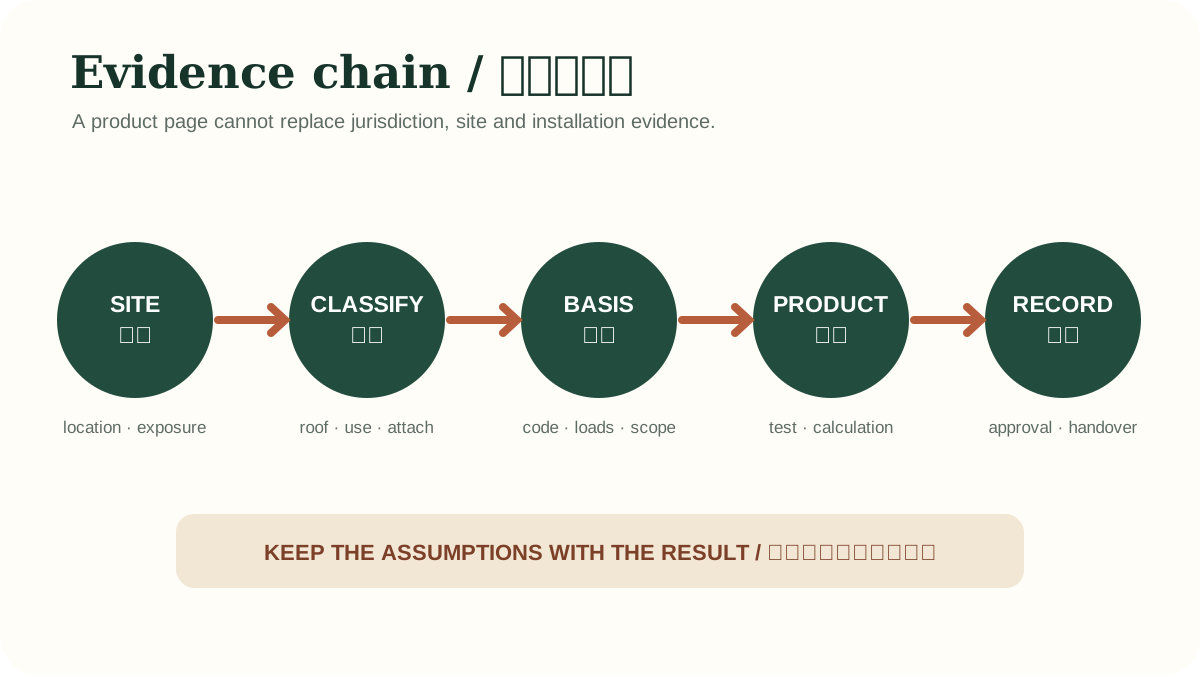
Read a detailed text description
Five linked blocks run from project address and site facts to legal classification, adopted design basis, product-specific evidence and final approval or inspection records. Feedback arrows show that a mismatch in configuration, location or assumptions must be resolved rather than skipped by relying on a generic certificate.
Key takeaways
- Normalize quotation scope before comparing totals.View claim record ·
PWC-BUDGET-AND-LIFECYCLE-COST-1 - Low initial cost can exclude engineering, foundations, drainage, electrical work, access or evidence.View claim record ·
PWC-BUDGET-AND-LIFECYCLE-COST-2 - A lifecycle budget separates durable structure from replaceable seals, fabric, motors, finishes and controls.View claim record ·
PWC-BUDGET-AND-LIFECYCLE-COST-3
The claim register connects stable IDs, article locations and article-level associated sources; it is not an external fact-check of each statement.
On this page
Build one comparison brief
Give every bidder the same site information, dimensions, roof state, finishes, services, performance questions, approval responsibility and handover requirements. Mark unknowns rather than allowing each quotation to assume a different answer. A price comparison is not meaningful when one offer includes foundations and drainage while another stops at a delivery-only frame.
Separate the cost layers
Record product supply, transport, access equipment, demolition, foundations, structural verification, permits, installation, waterproofing, drainage, electrical work, commissioning and reinstatement as separate lines. Add provisional items only with a stated basis and owner. This structure makes omissions visible without inventing universal market prices.
Official abstract establishing a lifecycle framework from briefing and design through maintenance, replacement, reuse and disposal.
Price the evidence and responsibility
A complete technical submittal, coordinated drawing and named responsibility can cost more than a product sheet, but they reduce ambiguity. Ask who verifies the site, existing building, actions, anchors, drainage and final installation. A warranty does not replace engineering evidence, and a calculation does not automatically include installation inspection.
Model replaceable components
Frames, finishes, fabric, seals, motors, sensors, lighting and control equipment can have different inspection and replacement cycles. Record access and labor as well as component cost. A cheaper concealed motor may be expensive to replace if roof disassembly is required, while a maintainable drain or replaceable seal can reduce repeated disruption.
US model-code provisions for residential patio covers; only applicable where adopted.
Include exposure and change risk
Coastal salt, snow, heavy rain, difficult access, unknown substrates and buried services can change detailing, inspection and contingency. Screens, glazing, kitchens, heaters or solar panels added later can reopen structural and approval work. Keep a change allowance tied to identified uncertainties rather than an unexplained percentage presented as certainty.
Compare value with a decision record
Score each option against the same needs: usable layout, verified performance, approval path, maintainability, replacement access, document quality and residual uncertainty. Record exclusions and the reason for the selection. The goal is not the lowest number or the most features; it is the clearest fit between project needs, evidence, responsibility and whole-life effort.
Official standard hub for US structural actions including wind, snow, rain, seismic and load combinations.
Evidence check before acting
This article provides general educational synthesis; these three checks turn reading into project-specific verification work.
| Confirm | Stronger evidence to retain | What this article cannot establish |
|---|---|---|
| Jurisdiction, adopted edition, local amendments, use, site constraints and permit pathway | Written authority guidance, current adopted text and project permit documents | A model code, national guide or neighboring approval does not establish local permission. |
Compare approval-verification pathways in other jurisdictions
Cross-jurisdiction comparison helps identify questions to ask; it does not transfer an exemption, code or approval outcome from one location to another.
Registered cited sources and scope
Official abstract establishing a lifecycle framework from briefing and design through maintenance, replacement, reuse and disposal.
US model-code provisions for residential patio covers; only applicable where adopted.
Official standard hub for US structural actions including wind, snow, rain, seismic and load combinations.
Residential coastal construction guidance addressing high winds, flooding, erosion, corrosion-sensitive detailing and other hazards.
Cite this page
Pergola Wiki Editorial Team. “Pergola budget and lifecycle cost.” Pergola Wiki. Content version 1.7; editorially reviewed 25 Jul 2026. https://pergola.wiki/articles/budget-and-lifecycle-cost/