Who created this, how it was made and why it exists
- Who
- Published under the organizational identity Pergola Wiki Editorial Team; neither AI nor the organization is presented as a named professional individual.
- How
- AI assistance was used for drafting, translation, source-metadata organization, static-site coding and automated QA in a publisher-directed workflow. Automated checks do not establish technical correctness.
- Why
- To provide free bilingual educational synthesis; one disclosed Oscar Pergola industry link does not determine conclusions, source tiers or rankings.
Read a detailed text description
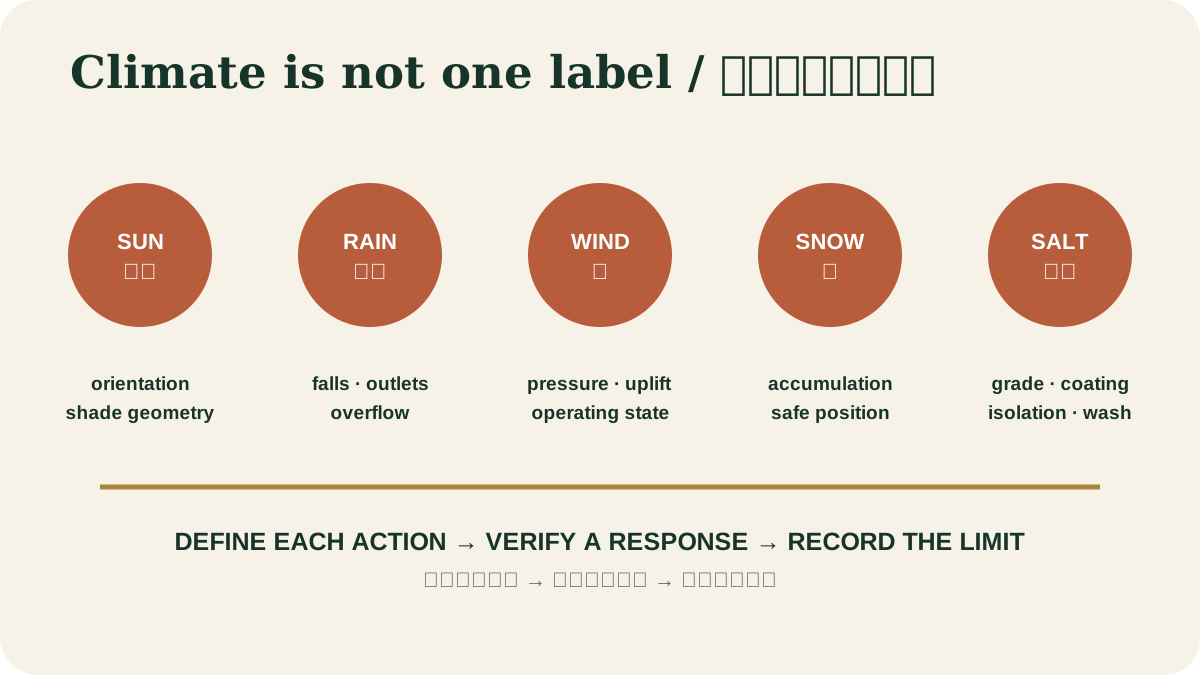
Separate inputs for solar orientation, rainfall, wind, snow or ice and corrosive exposure feed into different design responses. These responses include shade geometry, drainage and overflow, structural operating states, material and finish selection, maintenance access and project-specific controls.
Key takeaways
- Define acceptable water entry.View claim record ·
PWC-WATERPROOF-VS-WATER-RESISTANT-1 - Test the exact configuration.View claim record ·
PWC-WATERPROOF-VS-WATER-RESISTANT-2 - Drainage and overflow are part of the claim.View claim record ·
PWC-WATERPROOF-VS-WATER-RESISTANT-3
The claim register connects stable IDs, article locations and article-level associated sources; it is not an external fact-check of each statement.
On this page
Translate marketing language
“Water-resistant” may mean material does not readily absorb water, while “rain-shedding” may allow droplets at joints and “watertight” requires a stated test boundary. Ask what area, duration, rainfall rate, wind pressure, louver position and leakage criterion support the claim.
Test the system, not a sample
A blade coupon cannot prove corner joints, gutters, posts and building interfaces. The tested size, slope, bay arrangement, seals, outlets and controls should match the project or have a documented engineering basis for extension. Field testing verifies installation but does not create an unsupported product rating.
Official standard hub for US structural actions including wind, snow, rain, seismic and load combinations.
Plan for overflow
Every collected-water system can encounter blockage or rainfall beyond its design basis. Provide an overflow route that is visible, does not enter electrical or structural cavities and does not discharge onto a hazardous surface. Concealed uncontrolled overflow is a defect even if it occurs only during exceptional rain.
Use a commissioning record
Record test setup, flow or rainfall basis, duration, louver positions, blocked-outlet scenario, observations during and after flow, corrective work and retest. Photographs of internal channels before closure make later diagnosis faster.
US model-code provisions for residential patio covers; only applicable where adopted.
Evidence check before acting
This article provides general educational synthesis; these three checks turn reading into project-specific verification work.
| Confirm | Stronger evidence to retain | What this article cannot establish |
|---|---|---|
| Wind, rain, snow, heat, exposure class, drainage capacity and control fail-state | Local climate data, declared test scope, project design documents and commissioning records | One rating or laboratory result does not establish whole-system performance in every configuration. |
Registered cited sources and scope
Official standard hub for US structural actions including wind, snow, rain, seismic and load combinations.
US model-code provisions for residential patio covers; only applicable where adopted.
Cite this page
Pergola Wiki Editorial Team. “Waterproof, water-resistant and rain-shedding claims.” Pergola Wiki. Content version 1.7; editorially reviewed 25 Jul 2026. https://pergola.wiki/articles/waterproof-vs-water-resistant/