Who created this, how it was made and why it exists
- Who
- Published under the organizational identity Pergola Wiki Editorial Team; neither AI nor the organization is presented as a named professional individual.
- How
- AI assistance was used for drafting, translation, source-metadata organization, static-site coding and automated QA in a publisher-directed workflow. Automated checks do not establish technical correctness.
- Why
- To provide free bilingual educational synthesis; one disclosed Oscar Pergola industry link does not determine conclusions, source tiers or rankings.
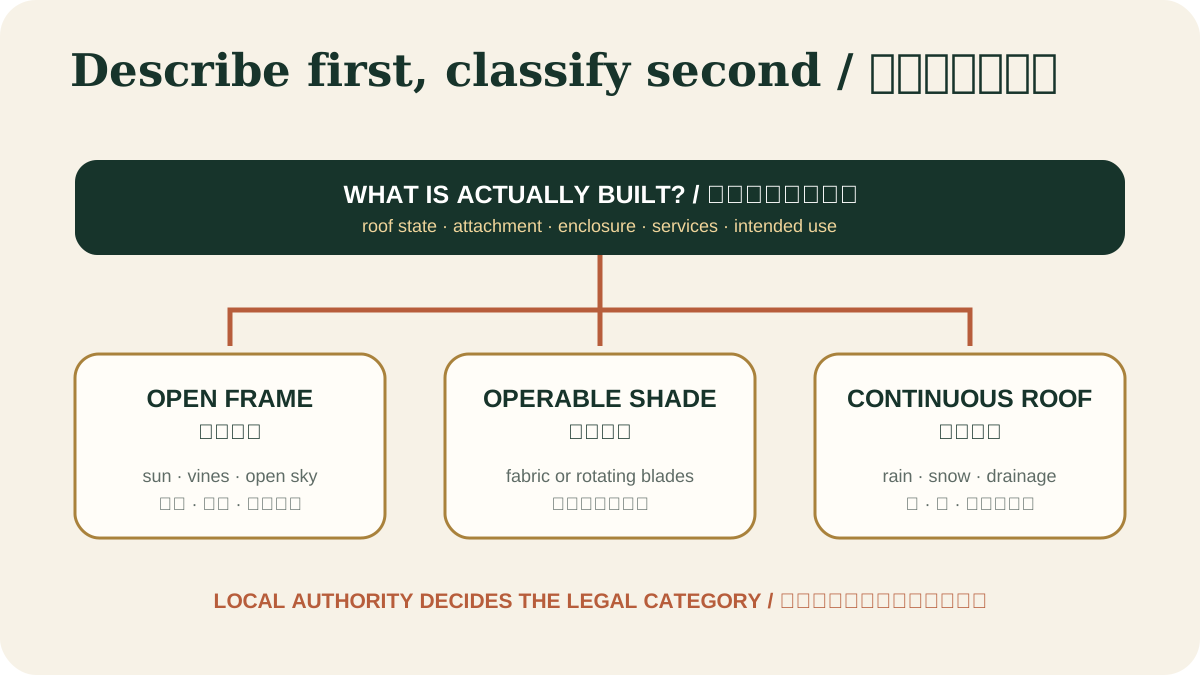
Read a detailed text description
The diagram branches from the shared name “pergola” into three overhead conditions: an open frame that lets rain pass, an operable cover whose state changes, and a continuous roof that collects water. Each branch then points readers to verify attachment, enclosure, services, structural actions, drainage and the local approval pathway.
Key takeaways
- There is no universal compass direction for laying canisse: the verified product face, roll construction, support grid, edge restraint and drainage path control the layout.View claim record ·
PWC-RETRACTABLE-CANOPY-1 - A shade mat is neither a verified rain roof nor a harmless decoration; it changes wind area, retained moisture, maintenance access and sometimes planning or fire exposure.View claim record ·
PWC-RETRACTABLE-CANOPY-2 - Use product- and site-specific fixing and removal rules, and stop use when the cover, ties, supports, drainage or nearby electrical and hot components cannot be inspected or kept safe.View claim record ·
PWC-RETRACTABLE-CANOPY-3
The claim register connects stable IDs, article locations and article-level associated sources; it is not an external fact-check of each statement.
On this page
- Answer the installation-direction question first
- Classify the cover before choosing details
- Check the existing frame and every interface
- Use the French canisse study within its boundary
- Keep shade separate from rain protection
- Plan wind, weather and removal states
- Treat fire and hot components as site questions
- Verify planning and appearance changes locally
- Retractable and canisse cover FAQ
- Specify the fabric as a replaceable assembly
- Look for progressive warning signs
- Keep drive evidence within its boundary
Answer the installation-direction question first
For the query sens de pose de canisse sur pergola, do not begin with a universal north-south or reed-direction rule. Identify the exact mat, its intended exposed face and roll direction, the pergola's verified support lines, every free edge and the route for water and debris. Lay out the rolls so the manufacturer's fixing method can restrain both the field and perimeter without tying into gutters, wiring, louver blades or unverified decorative members. If those facts are absent, the defensible answer is to obtain the product instruction and redesign the support layout—not invent a spacing or direction.
Classify the cover before choosing details
Separate retractable fabric, removable natural canisse, fixed panels and planted canopies. A manually drawn or motorized textile has tracks, tension and operating states; a reed, split-bamboo or heather mat has distributed ties, exposed cut edges and wet organic material; a continuous panel collects rain; vegetation grows and changes over time. One category's fixing, drainage or wind rule does not transfer to another.
Government guidance on exterior overhangs, sunscreens and solar heat gain.
Check the existing frame and every interface
Record member sizes, condition, spans, connections, foundations and whether the original design included an added cover. Map fasteners, drainage, electricity, heaters, cooking appliances and moving components before work starts. A light dry roll can still create a broad wind-catching surface and retain water or debris. No generic tie interval or wind speed can replace the cover instructions, supporting-frame evidence and site wind basis.
Use the French canisse study within its boundary
An Indre government-hosted college study shows one bamboo-or-heather canisse proposal laid over an existing transparent canopy and fixed to its frame. The same document flags wet-period rot or fungal growth and replacement after some years. This is evidence that moisture and replacement access belong in the brief; its project sketch and approximate five-year replacement note are not a universal installation detail, warranty or service-life value.
A site-specific French college adaptation study showing bamboo or heather canisses placed over an existing transparent canopy and fixed to the existing frame, with wet-period rot or fungal growth and eventual replacement identified as constraints. Its layout and approximate replacement timing are not a universal installation detail or service-life claim.
Keep shade separate from rain protection
Canisse, open-weave fabric and planted cover can interrupt solar radiation while still admitting wind-driven rain, drips and debris. Do not describe them as waterproof without assembly-specific test evidence. Preserve drainage and overflow paths below or around the cover, avoid concealed wet contact, and provide a drying and inspection condition. Water pockets, persistent sagging, staining, fungal growth or blocked outlets require correction before continued use.
Plan wind, weather and removal states
Write the installed, retracted or removed state for normal use, forecast wind, storms, snow, freezing conditions and prolonged vacancy. Retractable systems need documented control and power-failure behavior; removable mats need an accessible release and storage plan that does not require unsafe roof access during an event. Stop use for loose ties, torn edges, progressive lift, distorted supports, jammed tracks or any cover that cannot drain and dry as intended.
Departmental wildfire guidance stating that an attached pergola or awning covered with fabric, canisse or vegetation can ignite and promote fire spread to a dwelling. It is a French wildfire-vulnerability source, not a material fire classification, global clearance rule or product test.
Treat fire and hot components as site questions
Bouches-du-Rhône wildfire guidance states that a pergola or awning covered with fabric, canisse or vegetation can ignite and promote fire spread to a dwelling. Apply that statement only to its French wildfire-vulnerability context; it is not a global fire rating or clearance. Check the local hazard rules and verified clearances from heaters, luminaires, cooking appliances, chimneys and electrical equipment, and keep dry debris from accumulating.
Verify planning and appearance changes locally
France's Service-Public guidance makes pergola authorization depend on the local plan, location, project classification and footprint. It does not decide whether one removable mat changes one existing approval. Record the before-and-after configuration and ask the competent authority when the cover alters appearance, roof state, attachment, area or use; do not transfer French thresholds outside France.
Official French planning guidance explaining that the applicable filing depends on local planning rules, location, project classification and footprint. It does not determine whether adding a removable shade mat changes a specific project's authorization and does not apply outside France.
Retractable and canisse cover FAQ
Which way should canisse run? Along the verified support and restraint layout required by the exact product, not a universal compass direction. Can it make a pergola waterproof? Not without assembly-specific rain evidence and a continuous drainage design. Is natural canisse automatically safer or more sustainable? No: origin, treatment, durability, replacement, fire exposure and end-of-life evidence must be checked separately.
Specify the fabric as a replaceable assembly
Record fabric type, coating, seam method, UV exposure class, cleaning method, minimum operating temperature and replacement access. The frame may outlast several fabric cycles. A useful lifecycle plan therefore separates durable rails and supports from consumable textile, cord, belt and carriage components.
Official abstract establishing a lifecycle framework from briefing and design through maintenance, replacement, reuse and disposal.
Look for progressive warning signs
Uneven folds, edge abrasion, asymmetric travel, water pockets and repeated motor trips are early indicators—not merely cosmetic issues. Stop operation when fabric or hardware can snag. Correct the alignment, tension or drainage cause before replacing a damaged textile, otherwise the new component inherits the same failure mechanism.
Keep drive evidence within its boundary
IEC 60335-2-97 can be relevant to the safety of an electric awning drive, but it does not establish fabric strength, track anchorage, wind operating limits, drainage or the structural capacity of the supporting pergola. Procurement should keep the drive, moving fabric assembly, controls, frame and site installation evidence distinct and then verify their interfaces.
Official standard hub for US structural actions including wind, snow, rain, seismic and load combinations.
Evidence check before acting
This article provides general educational synthesis; these three checks turn reading into project-specific verification work.
| Confirm | Stronger evidence to retain | What this article cannot establish |
|---|---|---|
| Actual roof movement, attachment and enclosure | Measured drawings, photographs and the local authority's classification path | A product name or visual resemblance does not establish the legal or structural category. |
Registered cited sources and scope
Government guidance on exterior overhangs, sunscreens and solar heat gain.
A site-specific French college adaptation study showing bamboo or heather canisses placed over an existing transparent canopy and fixed to the existing frame, with wet-period rot or fungal growth and eventual replacement identified as constraints. Its layout and approximate replacement timing are not a universal installation detail or service-life claim.
Departmental wildfire guidance stating that an attached pergola or awning covered with fabric, canisse or vegetation can ignite and promote fire spread to a dwelling. It is a French wildfire-vulnerability source, not a material fire classification, global clearance rule or product test.
Official French planning guidance explaining that the applicable filing depends on local planning rules, location, project classification and footprint. It does not determine whether adding a removable shade mat changes a specific project's authorization and does not apply outside France.
Official abstract establishing a lifecycle framework from briefing and design through maintenance, replacement, reuse and disposal.
Official standard hub for US structural actions including wind, snow, rain, seismic and load combinations.
International safety requirements for household and similar electric drives used with shutters, awnings, blinds and related equipment. It does not replace local electrical installation rules or verify a complete pergola system.
Cite this page
Pergola Wiki Editorial Team. “Pergola canisse mats and retractable shade covers.” Pergola Wiki. Content version 1.7.10; editorially reviewed 20 Aug 2026. https://pergola.wiki/articles/retractable-canopy/