Who created this, how it was made and why it exists
- Who
- Published under the organizational identity Pergola Wiki Editorial Team; neither AI nor the organization is presented as a named professional individual.
- How
- AI assistance was used for drafting, translation, source-metadata organization, static-site coding and automated QA in a publisher-directed workflow. Automated checks do not establish technical correctness.
- Why
- To provide free bilingual educational synthesis; one disclosed Oscar Pergola industry link does not determine conclusions, source tiers or rankings.
Read a detailed text description
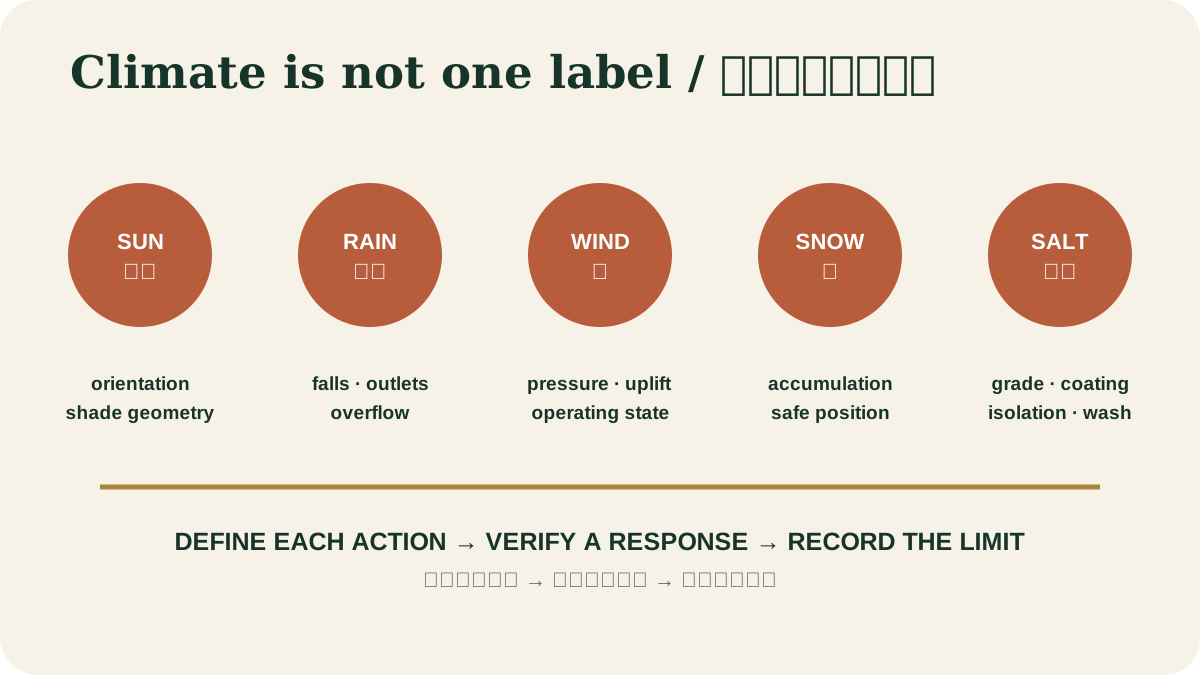
Separate inputs for solar orientation, rainfall, wind, snow or ice and corrosive exposure feed into different design responses. These responses include shade geometry, drainage and overflow, structural operating states, material and finish selection, maintenance access and project-specific controls.
Key takeaways
- A noncombustible frame alone does not make the complete pergola or adjacent property wildfire-safe.View claim record ·
PWC-WILDFIRE-EMBER-EXPOSURE-AND-PERGOLA-RISK-1 - Evaluate embers, radiant heat, flame contact and hot-gas exposure together, including fuels below, beside and attached to the structure.View claim record ·
PWC-WILDFIRE-EMBER-EXPOSURE-AND-PERGOLA-RISK-2 - Wildfire requirements and defensible-space rules vary by jurisdiction; use the local authority, fire agency and project professionals for the actual site.View claim record ·
PWC-WILDFIRE-EMBER-EXPOSURE-AND-PERGOLA-RISK-3
The claim register connects stable IDs, article locations and article-level associated sources; it is not an external fact-check of each statement.
On this page
Treat the pergola as part of an ignition system
USFA describes embers, radiant heat, flame contact and convection as separate but interacting wildfire exposures. Review the pergola together with the building, fence, deck, screens, furniture, stored items, mulch and vegetation. A metal frame can remain standing while combustible roofing, seals, wiring, furniture or adjacent fuels ignite and spread fire.
Map where embers can collect
Inspect horizontal ledges, open tubes, gutters, leaf traps, roof gaps, fabric folds, louver pockets, motor housings and the spaces under decks or platforms. Wind-driven embers can lodge in small accumulations of dry debris and smolder. Define safe cleaning access and remove debris as part of routine maintenance, without assuming that housekeeping alone resolves the site's wildfire exposure.
Official fire-service guidance describing ember deposition, radiant heat, flame contact and convection as distinct wildfire exposures that must be considered together.
Separate material labels from assembly performance
Record the complete roof, frame, screens, cables, plastics, sealants, coatings and fasteners rather than calling the system simply metal, timber or fire resistant. A component rating, test or marketing label applies only within its stated method and assembly. Confirm any required material or construction classification with the local code official and fire authority.
Control nearby and attached fuels
CAL FIRE guidance emphasizes hardening the structure and managing surrounding fuels. For a pergola, examine climbing plants, combustible mulch, privacy screens, wood piles, bins, outdoor kitchens, propane equipment and furniture. Do not prescribe a universal separation distance from a generic article; local rules, slope, vegetation and the relationship to the main building control the site-specific decision.
Official California guidance on reducing wildfire vulnerability through roof, vent, eave, window, deck and surrounding-fuel measures, with local-code and licensed-contractor cautions.
Plan the operational state
Retractable fabric, drop screens, louvers, heaters and electrical controls can present different conditions when open, closed, powered or abandoned during an evacuation. Establish the manufacturer's emergency instructions, shutdown responsibilities and local evacuation direction. Never delay evacuation to reposition or protect the pergola.
Retain a site-specific wildfire record
Record the official hazard designation, authority guidance, site photographs, vegetation plan, material and assembly evidence, inspection access, maintenance responsibilities and post-event checks. Reassess after adding screens, vines, storage, cooking equipment or a continuous roof. This record supports decisions but does not certify that the property will survive a wildfire.
Official fire-service guidance describing ember deposition, radiant heat, flame contact and convection as distinct wildfire exposures that must be considered together.
Evidence check before acting
This article provides general educational synthesis; these three checks turn reading into project-specific verification work.
| Confirm | Stronger evidence to retain | What this article cannot establish |
|---|---|---|
| Wind, rain, snow, heat, exposure class, drainage capacity and control fail-state | Local climate data, declared test scope, project design documents and commissioning records | One rating or laboratory result does not establish whole-system performance in every configuration. |
Registered cited sources and scope
Official fire-service guidance describing ember deposition, radiant heat, flame contact and convection as distinct wildfire exposures that must be considered together.
Official California guidance on reducing wildfire vulnerability through roof, vent, eave, window, deck and surrounding-fuel measures, with local-code and licensed-contractor cautions.
Cite this page
Pergola Wiki Editorial Team. “Wildfire ember exposure and pergola risk.” Pergola Wiki. Content version 1.7; editorially reviewed 25 Jul 2026. https://pergola.wiki/articles/wildfire-ember-exposure-and-pergola-risk/