Who created this, how it was made and why it exists
- Who
- Published under the organizational identity Pergola Wiki Editorial Team; neither AI nor the organization is presented as a named professional individual.
- How
- AI assistance was used for drafting, translation, source-metadata organization, static-site coding and automated QA in a publisher-directed workflow. Automated checks do not establish technical correctness.
- Why
- To provide free bilingual educational synthesis; one disclosed Oscar Pergola industry link does not determine conclusions, source tiers or rankings.
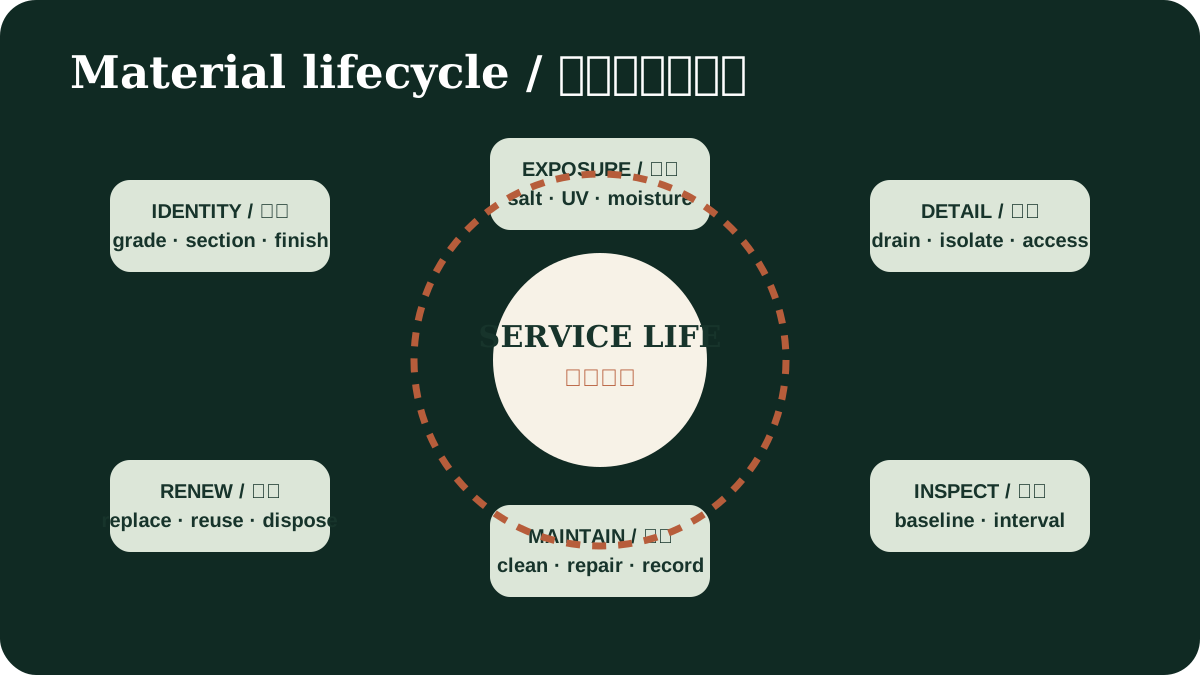
Read a detailed text description
The maintenance loop connects known material and exposure conditions with inspection intervals, recorded findings, cleaning or repair and eventual renewal. Each completed record informs the next inspection, helping recurrent drainage, coating, fastener or movement problems become visible over time.
Key takeaways
- A vegetated pergola is an open frame carrying trained climbing plants; it is not automatically a watertight roof or a substrate-based green roof.View claim record ·
PWC-CLIMBING-PLANTS-AND-STRUCTURAL-CARE-1 - Plant shade can improve a studied microclimate, but no single cooling value transfers across climates, orientations, seasons or canopy conditions.View claim record ·
PWC-CLIMBING-PLANTS-AND-STRUCTURAL-CARE-2 - Select locally suitable plants and a maintainable support system while keeping wet growth clear of drainage, moving parts, electricity and structural inspection points.View claim record ·
PWC-CLIMBING-PLANTS-AND-STRUCTURAL-CARE-3
The claim register connects stable IDs, article locations and article-level associated sources; it is not an external fact-check of each statement.
On this page
- What a ‘pergola végétalisée’ is—and is not
- Write the shade and planting brief first
- Use cooling evidence without inventing a rating
- Choose plants for the place, not a universal list
- Match the climbing method to a replaceable support
- Keep water, roots and maintenance visible
- Reopen the structural and wind brief
- Protect roofs, drains, electricity and fire clearances
- Run a seasonal inspection and stop-use cycle
- Vegetated pergola FAQ
What a ‘pergola végétalisée’ is—and is not
The French query describes a pergola whose open frame supports a trained plant canopy. Keep it distinct from a green roof, where growing substrate, root control, waterproofing and drainage form roof layers, and from a closing louvered roof, where vegetation can obstruct motion. Leaves may intercept light and rain, but a plant canopy is not a verified weather-tight covering.
Write the shade and planting brief first
Define the occupied hours, summer and winter sun, evergreen or deciduous behavior, desired canopy density, flower or fruit drop, root space, irrigation source, local biodiversity objective and available pruning skill. ADEME recommends deciduous planting where summer shade and winter solar access are both intended, but orientation, climate and the specific site still control the result.
Government technical reference on wood properties, moisture, decay, fasteners and design.
Use cooling evidence without inventing a rating
French public guidance describes shade and evapotranspiration as useful heat-adaptation mechanisms. Direct studies in Nagoya and Lleida also report context-specific differences under plant-covered pergolas. Their climates, dates, participants or instruments, orientations and plant maturity differ, so the results support a design mechanism—not a universal air-temperature reduction, comfort guarantee or product score.
Choose plants for the place, not a universal list
Check climate, exposure, soil or container volume, water demand, mature vigor, attachment behavior, toxicity, allergens, invasive-species status and pruning access with a locally competent horticultural source. France’s OFB ‘Végétal local’ framework is region-specific and distinguishes biogeographic origin from a generic species name; it is useful in France but is not a global plant-selection rule.
Official abstract for corrosivity categories affecting steel coating selection.
Match the climbing method to a replaceable support
Some plants self-cling, some twine around supports and others need tying. Paris guidance explains these categories for vertical greening; transfer the mechanism cautiously to a pergola. Use accessible wires, trellis panels or replaceable ties sized and spaced for the selected plant. Do not use gutters, cable clips, louver blades, sensors or sealant joints as plant supports.
Keep water, roots and maintenance visible
Prefer a planting arrangement whose soil, irrigation, overflow and root zone can be inspected without wetting post bases or discharging into concealed cavities. Dense growth can hide corrosion, timber decay, loose connections and coating failure. Leave working separation for pruning, recoating, drainage cleaning and inspection rather than allowing the canopy to fuse with the frame or adjacent wall.
Official abstract establishing a lifecycle framework from briefing and design through maintenance, replacement, reuse and disposal.
Reopen the structural and wind brief
Mature stems, wet foliage and trapped debris add persistent weight, while a dense canopy changes wind exposure. The effects depend on species, density, season, support geometry and site wind and cannot be reduced to a generic kilograms-per-square-metre allowance. Retain the project’s structural basis and obtain project-specific review if vegetation was not included in the original actions and connections.
Protect roofs, drains, electricity and fire clearances
Keep gutters, overflows, post drains, roof joints, motors, shafts, blade gaps, rain sensors, luminaires, heaters and isolation points outside the growing envelope. Define a vegetation exclusion zone for every moving or hot component and inspect it before operation. A rain sensor concealed by foliage may no longer represent the exposure it was intended to detect.
Official standard hub for US structural actions including wind, snow, rain, seismic and load combinations.
Run a seasonal inspection and stop-use cycle
Record training, pruning, tie replacement, irrigation checks, drain cleaning and structural inspection. Check after storms and before active growth. Remove dead or overloaded growth progressively rather than pulling against the frame. Stop normal use when plants conceal deformation, decay, active corrosion, displaced supports or wet electrical parts until the affected area is exposed and assessed.
Vegetated pergola FAQ
Does a green pergola guarantee a cooler space? No: it can alter shade, radiant exposure and evapotranspiration, but the outcome is site- and canopy-specific. Should vines grow directly on a louvered roof? No: keep plants on an independent, maintainable support outside the moving envelope. Which plant is best? There is no universal answer; use local climate, origin, vigor, water, attachment, safety and maintenance criteria.
French public guidance connecting terrace shade, pergolas, vegetation and evapotranspiration, and recommending deciduous planting where summer shade and winter solar access are intended. It is household heat-adaptation guidance, not a pergola cooling rating or plant-selection rule for other climates.
Evidence check before acting
This article provides general educational synthesis; these three checks turn reading into project-specific verification work.
| Confirm | Stronger evidence to retain | What this article cannot establish |
|---|---|---|
| Installed model, environment, service history, current condition and safe access | Manufacturer instructions, dated logs, photographs and competent inspection where risk warrants | A calendar interval or warranty period does not establish present condition or remaining life. |
Registered cited sources and scope
Government technical reference on wood properties, moisture, decay, fasteners and design.
Official abstract for corrosivity categories affecting steel coating selection.
Official abstract establishing a lifecycle framework from briefing and design through maintenance, replacement, reuse and disposal.
Official standard hub for US structural actions including wind, snow, rain, seismic and load combinations.
French public guidance connecting terrace shade, pergolas, vegetation and evapotranspiration, and recommending deciduous planting where summer shade and winter solar access are intended. It is household heat-adaptation guidance, not a pergola cooling rating or plant-selection rule for other climates.
French public-sector study describing vegetated pergolas as shade devices for seating or pedestrian routes and discussing radiant-exposure and summer-comfort mechanisms. It is local planning evidence, not a controlled product test or a transferable temperature guarantee.
Official French framework for traceable wild plants matched to defined biogeographic regions. It supports a France-specific local-origin and biodiversity check; it does not name a universally suitable pergola climber or replace site horticultural assessment.
Paris guidance distinguishing self-clinging, twining and tied climbing plants and noting the water, nutrient and maintenance burden of off-ground systems. The support mechanisms inform a pergola brief, but the page addresses Paris building greening and does not establish pergola structural capacity.
Direct pergola-shade field study in Nagoya with 42 collegiate male participants and ETU, UTCI and OUT_SET* indices. Reported index differences are specific to its climate, dates, subjects, radiation and plant-shade setup and are not universal air-temperature reductions.
Case study comparing two otherwise similar pergolas with greenery and rope shade in Lleida, Spain. Reported temperature differences depend on orientation, dates, climate and setup and cannot be generalized to other projects.
Cite this page
Pergola Wiki Editorial Team. “Vegetated pergola: plants, shade and structural care.” Pergola Wiki. Content version 1.7.9; editorially reviewed 19 Aug 2026. https://pergola.wiki/articles/climbing-plants-and-structural-care/