Who created this, how it was made and why it exists
- Who
- Published under the organizational identity Pergola Wiki Editorial Team; neither AI nor the organization is presented as a named professional individual.
- How
- AI assistance was used for drafting, translation, source-metadata organization, static-site coding and automated QA in a publisher-directed workflow. Automated checks do not establish technical correctness.
- Why
- To provide free bilingual educational synthesis; one disclosed Oscar Pergola industry link does not determine conclusions, source tiers or rankings.
Read a detailed text description
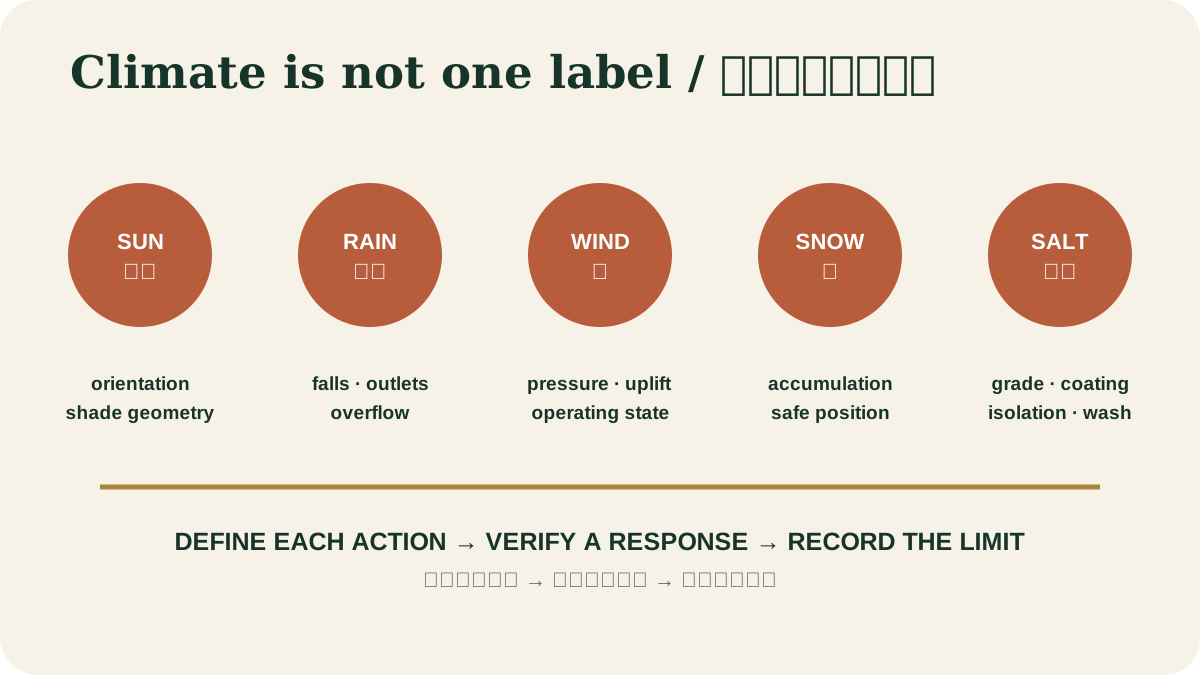
Separate inputs for solar orientation, rainfall, wind, snow or ice and corrosive exposure feed into different design responses. These responses include shade geometry, drainage and overflow, structural operating states, material and finish selection, maintenance access and project-specific controls.
Key takeaways
- Pergola-specific studies exist, but their climates, subjects, geometry, vegetation, dates and thermal indices prevent one universal cooling number.View claim record ·
PWC-HEAT-SHADE-AND-OUTDOOR-THERMAL-COMFORT-1 - Direct pergola evidence and broader tree, building or photovoltaic shade evidence answer different questions and must be labelled separately.View claim record ·
PWC-HEAT-SHADE-AND-OUTDOOR-THERMAL-COMFORT-2 - Improved comfort is not proof of heat safety; official alerts, vulnerable users and access to cooler shelter still govern operations.View claim record ·
PWC-HEAT-SHADE-AND-OUTDOOR-THERMAL-COMFORT-3
New or rewritten sections in this topic use section-mapped citations; the claim register remains editorial synthesis, not external fact-checking or independent review.
On this page
- Separate direct and indirect evidence
- What the Nagoya pergola field study establishes
- What the Lleida green-pergola case establishes
- What broader shade research contributes
- Do not average unlike metrics into one claim
- Match the metric to the decision
- Evaluate geometry at occupied positions
- Treat vegetation as a maintained assembly
- Keep heat safety independent from comfort
Separate direct and indirect evidence
A study that measures a plant-covered pergola can inform that apparatus and climate more directly than a study of tree shade, a building shadow or a photovoltaic canopy. Broader shade research remains useful for mechanisms and user response, but it must not be relabelled as a pergola product test. The evidence register therefore records directness before findings.
Direct pergola-shade field study in Nagoya with 42 collegiate male participants and ETU, UTCI and OUT_SET* indices. Reported index differences are specific to its climate, dates, subjects, radiation and plant-shade setup and are not universal air-temperature reductions.
Year-round hot-dry-climate study comparing tree and photovoltaic-canopy shade with 1,284 thermal-perception surveys. It provides broader shade evidence, not direct performance evidence for a particular pergola.
What the Nagoya pergola field study establishes
Watanabe and colleagues compared sunlight, building shade and plant-covered pergola shade during six summer experiment days in humid-subtropical Nagoya with 42 collegiate male participants. The paper reports ETU, UTCI and OUT_SET* results and finds lower ETU under pergola shade than sun in the stated conditions. Those are study-specific thermal-index differences—not universal air-temperature reductions or performance ratings.
Direct pergola-shade field study in Nagoya with 42 collegiate male participants and ETU, UTCI and OUT_SET* indices. Reported index differences are specific to its climate, dates, subjects, radiation and plant-shade setup and are not universal air-temperature reductions.
What the Lleida green-pergola case establishes
Vázquez and colleagues compared two otherwise similar pergolas with greenery and rope shade in a continental-Mediterranean setting. The study reported orientation- and time-specific air-temperature differences, including a maximum daytime west-side difference of 2.5 °C on one stated date. Its authors explicitly limit transfer to other situations and climates.
Case study comparing two otherwise similar pergolas with greenery and rope shade in Lleida, Spain. Reported temperature differences depend on orientation, dates, climate and setup and cannot be generalized to other projects.
What broader shade research contributes
Middel and colleagues used seasonal meteorological transects and 1,284 thermal-perception surveys in hot-dry Tempe to compare tree and photovoltaic-canopy shade. The work supports the conclusion that shade type, season and human response matter. It did not test a pergola and cannot verify a particular frame, roof, plant or product claim.
Year-round hot-dry-climate study comparing tree and photovoltaic-canopy shade with 1,284 thermal-perception surveys. It provides broader shade evidence, not direct performance evidence for a particular pergola.
Do not average unlike metrics into one claim
Air temperature, mean radiant temperature, ETU, UTCI, PET, OUT_SET*, humidity and subjective sensation are not interchangeable. A large change in a radiation-sensitive index may occur with little change in measured air temperature. Preserve the metric, units, comparison, time, radiation and uncertainty instead of publishing a detached headline number.
Direct pergola-shade field study in Nagoya with 42 collegiate male participants and ETU, UTCI and OUT_SET* indices. Reported index differences are specific to its climate, dates, subjects, radiation and plant-shade setup and are not universal air-temperature reductions.
Case study comparing two otherwise similar pergolas with greenery and rope shade in Lleida, Spain. Reported temperature differences depend on orientation, dates, climate and setup and cannot be generalized to other projects.
Match the metric to the decision
A weather-station air temperature measures one variable, and Heat Index combines temperature and humidity under shaded assumptions; neither establishes conditions at a sun-exposed, reflective or wind-blocked pergola. OSHA recommends on-site WBGT for workplace environmental heat because it incorporates temperature, humidity, radiant heat and air movement, while NWS distinguishes WBGT from Heat Index for vigorous activity in full sun. Record instrument location, shade or roof state, time, weather, nearby surfaces, air movement and activity. WBGT remains an occupational heat input—not a universal comfort score, residential closure rule or pergola product rating.
Official occupational guidance distinguishing air temperature, humidity, radiant heat and air movement; it recommends on-site WBGT for workplace heat assessment. It is a worker-safety source, not a residential comfort rating or pergola product test.
Official comparison stating that Heat Index assumes shade while WBGT incorporates additional solar and wind inputs. It supports metric selection and screening limits, not a site-specific safety threshold or product cooling claim.
Evaluate geometry at occupied positions
Model sun by latitude, season and intended hours, then review seated and standing positions, circulation and adjacent reflective surfaces. Open rafters, louvers, fabric and plants cast different moving patterns. Record operating state and plant maturity; a plan-view roof percentage does not describe the exposure experienced by a person.
Government guidance on exterior overhangs, sunscreens and solar heat gain.
Treat vegetation as a maintained assembly
Green shade depends on species, seasonal leaf state, irrigation, root space, plant health and pruning. Mature vegetation also adds weight, wind area, retained moisture and maintenance access. Do not assume an immature canopy gives immediate study-like shade or attach vines to an unverified frame.
Government evidence overview describing how vegetation can reduce local surface and air temperatures through shade and evapotranspiration.
Case study comparing two otherwise similar pergolas with greenery and rope shade in Lleida, Spain. Reported temperature differences depend on orientation, dates, climate and setup and cannot be generalized to other projects.
Keep heat safety independent from comfort
A shaded place can remain dangerously hot. Follow official local alerts and health guidance, identify vulnerable users, set closure and activity rules and provide a route to a cooler enclosed place. Fans, sensors and a favorable thermal index do not replace an extreme-heat operating plan.
Official heat-alert guidance covering postponement of outdoor activity, water, shade breaks and movement to a cool indoor place during dangerous heat.
Pergola thermal-comfort research register
The table labels directness, setting and transfer limits so unlike studies are not averaged into a product claim.
| Checkpoint | Define | Retain |
|---|---|---|
| PWT-001 — direct_pergola_field_study | Humid subtropical summer; Nagoya, Japan; Six experiment days in 2007; 42 collegiate male participants; sunlight, building shade and plant-covered pergola shade | ETU, UTCI, OUT_SET*, meteorological measurements and subjective questionnaires; limit: Participant group, short dates, climate, radiation, plant maturity and geometry limit transfer. Do not use the reported ETU differences as a universal pergola cooling rating. |
| PWT-002 — broader_shade_field_study | Hot-dry climate; Tempe, Arizona, United States; seasonal study; Year-round selected clear, calm days; 1,284 thermal-perception surveys with meteorological transects | Meteorological observations, thermal perception, comfort and preference surveys; limit: The study did not test a pergola. It supports a broader principle that shade type and context matter, not a pergola-product performance claim. |
| PWT-003 — direct_green_pergola_case_study | Continental Mediterranean climate; Lleida, Spain; summer 2019; Two otherwise similar pergolas comparing greenery with rope shade; east- and west-oriented sensors | Air temperature and relative humidity by orientation and time; limit: Single-site orientation, dates, plant state and apparatus limit transfer. The authors state that results cannot be generalized to all climates. |
Evidence check before acting
This article provides general educational synthesis; these three checks turn reading into project-specific verification work.
| Confirm | Stronger evidence to retain | What this article cannot establish |
|---|---|---|
| Wind, rain, snow, heat, exposure class, drainage capacity and control fail-state | Local climate data, declared test scope, project design documents and commissioning records | One rating or laboratory result does not establish whole-system performance in every configuration. |
Registered cited sources and scope
Direct pergola-shade field study in Nagoya with 42 collegiate male participants and ETU, UTCI and OUT_SET* indices. Reported index differences are specific to its climate, dates, subjects, radiation and plant-shade setup and are not universal air-temperature reductions.
Year-round hot-dry-climate study comparing tree and photovoltaic-canopy shade with 1,284 thermal-perception surveys. It provides broader shade evidence, not direct performance evidence for a particular pergola.
Case study comparing two otherwise similar pergolas with greenery and rope shade in Lleida, Spain. Reported temperature differences depend on orientation, dates, climate and setup and cannot be generalized to other projects.
Official heat-alert guidance covering postponement of outdoor activity, water, shade breaks and movement to a cool indoor place during dangerous heat.
Official occupational guidance distinguishing air temperature, humidity, radiant heat and air movement; it recommends on-site WBGT for workplace heat assessment. It is a worker-safety source, not a residential comfort rating or pergola product test.
Official comparison stating that Heat Index assumes shade while WBGT incorporates additional solar and wind inputs. It supports metric selection and screening limits, not a site-specific safety threshold or product cooling claim.
Government evidence overview describing how vegetation can reduce local surface and air temperatures through shade and evapotranspiration.
Government guidance on exterior overhangs, sunscreens and solar heat gain.
Cite this page
Pergola Wiki Editorial Team. “Pergola thermal comfort: shade and heat evidence.” Pergola Wiki. Content version 1.7.4; editorially reviewed 4 Aug 2026. https://pergola.wiki/articles/heat-shade-and-outdoor-thermal-comfort/