Who created this, how it was made and why it exists
- Who
- Published under the organizational identity Pergola Wiki Editorial Team; neither AI nor the organization is presented as a named professional individual.
- How
- AI assistance was used for drafting, translation, source-metadata organization, static-site coding and automated QA in a publisher-directed workflow. Automated checks do not establish technical correctness.
- Why
- To provide free bilingual educational synthesis; one disclosed Oscar Pergola industry link does not determine conclusions, source tiers or rankings.
Read a detailed text description
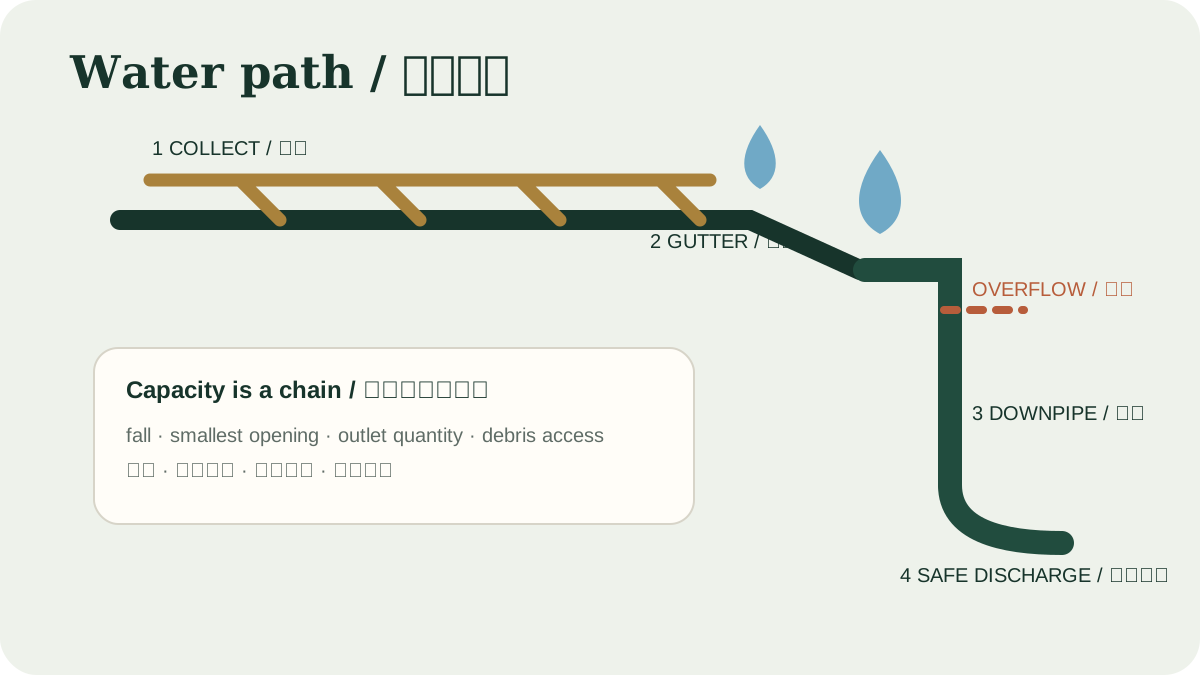
Arrows follow rainfall from the roof or closed louvers to falls and joints, then into gutters, outlets and downpipes before reaching a safe discharge point. A separate overflow path represents the backup route needed when the primary outlet is blocked or rainfall exceeds the assumed capacity.
Key takeaways
- The smallest outlet can control capacity.View claim record ·
PWC-LOUVER-GUTTER-DRAINAGE-1 - Level tolerances influence ponding and overflow.View claim record ·
PWC-LOUVER-GUTTER-DRAINAGE-2 - Concealed drainage must remain accessible for cleaning.View claim record ·
PWC-LOUVER-GUTTER-DRAINAGE-3
The claim register connects stable IDs, article locations and article-level associated sources; it is not an external fact-check of each statement.
On this page
Water path
Closed louvers shed water laterally into edge channels. The frame then conveys it to outlets, often through hollow posts. Each transition needs enough fall, free area and an overflow route that does not discharge against the building.
Failure signs
Drips at joints, staining below corners, slow drainage and water retained after rain can indicate blocked outlets, poor level, seal movement or insufficient fall. Maintenance instructions should identify clean-out points.
US model-code provisions for residential patio covers; only applicable where adopted.
Capacity is a chain, not one gutter size
Rain must pass from blade overlap to collection channel, corner transfer, post downpipe and final discharge. The smallest opening, poor level or debris-prone turn can control the chain. Record design rainfall basis, contributing area, outlet quantity, overflow route and whether wind-driven rain is inside the performance claim.
Test for duration and blocked scenarios
A useful test runs long enough to wet every path and reveal delayed leakage, then checks a partially restricted outlet without allowing damage. Observe joints after flow stops because retained water can leak later. Maintenance access should not require dismantling structural connections or electrical controls.
Official standard hub for US structural actions including wind, snow, rain, seismic and load combinations.
Start with location-specific rainfall, then verify the whole path
NOAA Atlas 14 provides U.S. precipitation-frequency estimates with uncertainty bounds, not a ready-made gutter size. Use the locally required rainfall basis, then check blade collection, channels, outlets, downpipes, blockage allowance, overflow route and final discharge as one system. Other countries require their own adopted rainfall and drainage references.
Evidence check before acting
This article provides general educational synthesis; these three checks turn reading into project-specific verification work.
| Confirm | Stronger evidence to retain | What this article cannot establish |
|---|---|---|
| Geometry, connection, load-transfer and drainage details at every interface | Approved details, manufacturer instructions and installation records | A rendering or component list does not establish an assembled system's load or water path. |
Registered cited sources and scope
US model-code provisions for residential patio covers; only applicable where adopted.
Official standard hub for US structural actions including wind, snow, rain, seismic and load combinations.
Location-specific U.S. precipitation-frequency estimates with confidence intervals for drainage and infrastructure design inputs. It does not size a pergola drainage system or replace local criteria.
Official transition page stating that NOAA Atlas 14 remains the current U.S. standard while Atlas 15 preliminary CONUS estimates are planned for September 2026 and published estimates for 2027. Preliminary or pilot data are not final design values.
Cite this page
Pergola Wiki Editorial Team. “Louvers, gutters and concealed drainage.” Pergola Wiki. Content version 1.7; editorially reviewed 25 Jul 2026. https://pergola.wiki/articles/louver-gutter-drainage/