Who created this, how it was made and why it exists
- Who
- Published under the organizational identity Pergola Wiki Editorial Team; neither AI nor the organization is presented as a named professional individual.
- How
- AI assistance was used for drafting, translation, source-metadata organization, static-site coding and automated QA in a publisher-directed workflow. Automated checks do not establish technical correctness.
- Why
- To provide free bilingual educational synthesis; one disclosed Oscar Pergola industry link does not determine conclusions, source tiers or rankings.
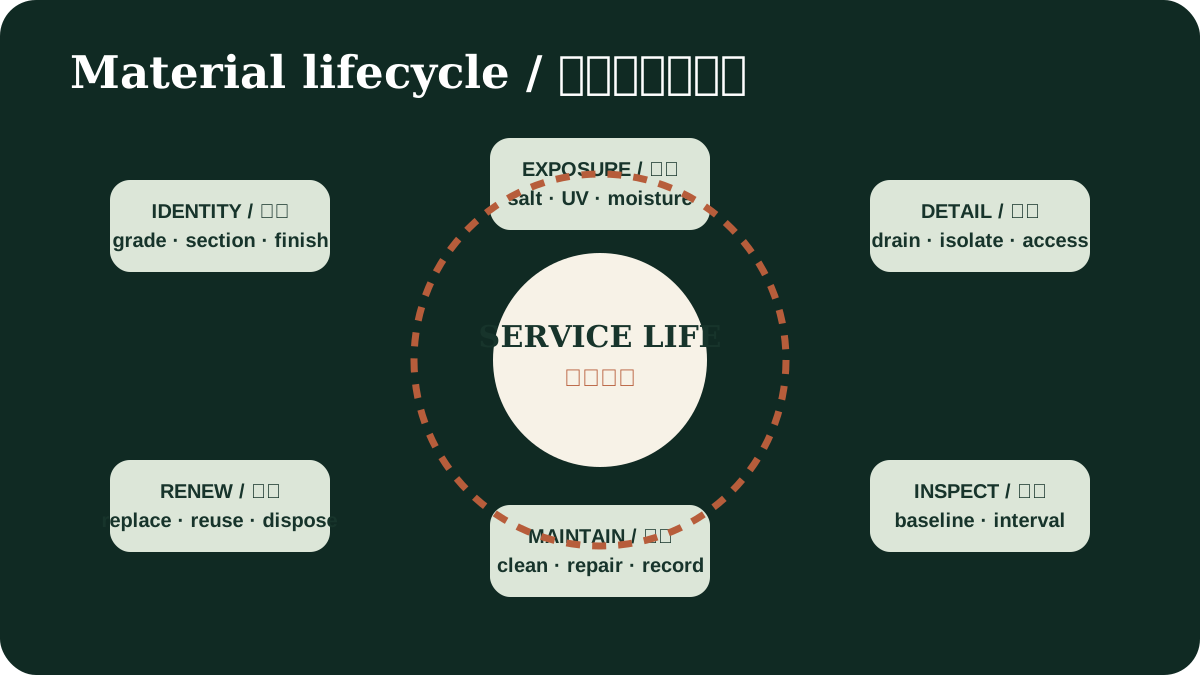
Read a detailed text description
The circular sequence begins with verified material identity and environmental exposure, then passes through protective detailing, inspection and maintenance before renewal or replacement feeds back into the next cycle. The loop shows that durability depends on traceable specification, compatible connections, drainage and recorded care rather than the material name alone.
Key takeaways
- A material name, recycled-content percentage or “eco” label does not describe the whole system life cycle.View claim record ·
PWC-SUSTAINABILITY-AND-CIRCULAR-DESIGN-1 - Long service life is valuable only when the structure, finishes, drainage, controls and replacement parts can be maintained and renewed.View claim record ·
PWC-SUSTAINABILITY-AND-CIRCULAR-DESIGN-2 - Credible procurement records the evidence boundary for material origin, environmental declarations, replaceability and end-of-use pathways.View claim record ·
PWC-SUSTAINABILITY-AND-CIRCULAR-DESIGN-3
The claim register connects stable IDs, article locations and article-level associated sources; it is not an external fact-check of each statement.
On this page
Define the unit being compared
Decide whether a claim covers raw material, an extrusion or board, one roof module, the complete pergola, installation, maintenance or end-of-use processing. Comparisons are misleading when their functional units, service periods, geography or system boundaries differ. Ask for the declared basis before comparing headline numbers.
Use life-cycle thinking
EPA sustainable materials management considers how materials are used and reused across their life cycles. For a pergola, that means coordinating extraction and manufacture with transport, installation waste, maintenance inputs, replacement cycles and end-of-use recovery. Moving impact outside the stated boundary does not remove it.
Government framework for using and reusing materials productively across their full life cycles.
Prioritize durability that can be maintained
Durability is not simply choosing the material with the longest generic lifespan. Exposure, grade, finish, water traps, fastener compatibility, access and maintenance determine whether the intended life can be reached. Record inspection intervals and renewal triggers so service-life assumptions become operational responsibilities.
Verify environmental claims
Request traceable product identity and the evidence behind recycled content, responsible sourcing, environmental product declarations or recovery claims. Check issuer, standard, declared product, plant, geography, date and life-cycle stages. Do not combine unrelated certifications into one unsupported claim that the complete pergola is sustainable.
Official abstract establishing a lifecycle framework from briefing and design through maintenance, replacement, reuse and disposal.
Design for repair and disassembly
Prefer inspectable connections, separable material layers, replaceable seals, accessible motors and documented spare parts where project constraints allow. Record adhesives, coatings and mixed-material interfaces that may frustrate repair or recovery. Disassembly intent needs compatible detailing and a realistic next user or recovery route.
Balance passive and powered performance
Orientation, adjustable shade and seasonal openness can reduce unwanted solar gain, but motors, lighting and heaters add energy, maintenance and replacement demands. Compare the actual operating brief, climate and hours of use. The most elaborate system is not automatically the lowest-impact solution.
Government technical reference on wood properties, moisture, decay, fasteners and design.
Evidence check before acting
This article provides general educational synthesis; these three checks turn reading into project-specific verification work.
| Confirm | Stronger evidence to retain | What this article cannot establish |
|---|---|---|
| Specified grade, finish system, exposure and compatible fasteners | Product traceability, mill or treatment records, finish data and project warranty terms | A generic material label does not establish grade, durability or suitability for the exposure. |
Registered cited sources and scope
Government framework for using and reusing materials productively across their full life cycles.
Official abstract establishing a lifecycle framework from briefing and design through maintenance, replacement, reuse and disposal.
Government technical reference on wood properties, moisture, decay, fasteners and design.
Official directory for aluminum standards, alloy data and errata.
Cite this page
Pergola Wiki Editorial Team. “Sustainability and circular pergola design.” Pergola Wiki. Content version 1.7; editorially reviewed 25 Jul 2026. https://pergola.wiki/articles/sustainability-and-circular-design/