Who created this, how it was made and why it exists
- Who
- Published under the organizational identity Pergola Wiki Editorial Team; neither AI nor the organization is presented as a named professional individual.
- How
- AI assistance was used for drafting, translation, source-metadata organization, static-site coding and automated QA in a publisher-directed workflow. Automated checks do not establish technical correctness.
- Why
- To provide free bilingual educational synthesis; one disclosed Oscar Pergola industry link does not determine conclusions, source tiers or rankings.
Read a detailed text description
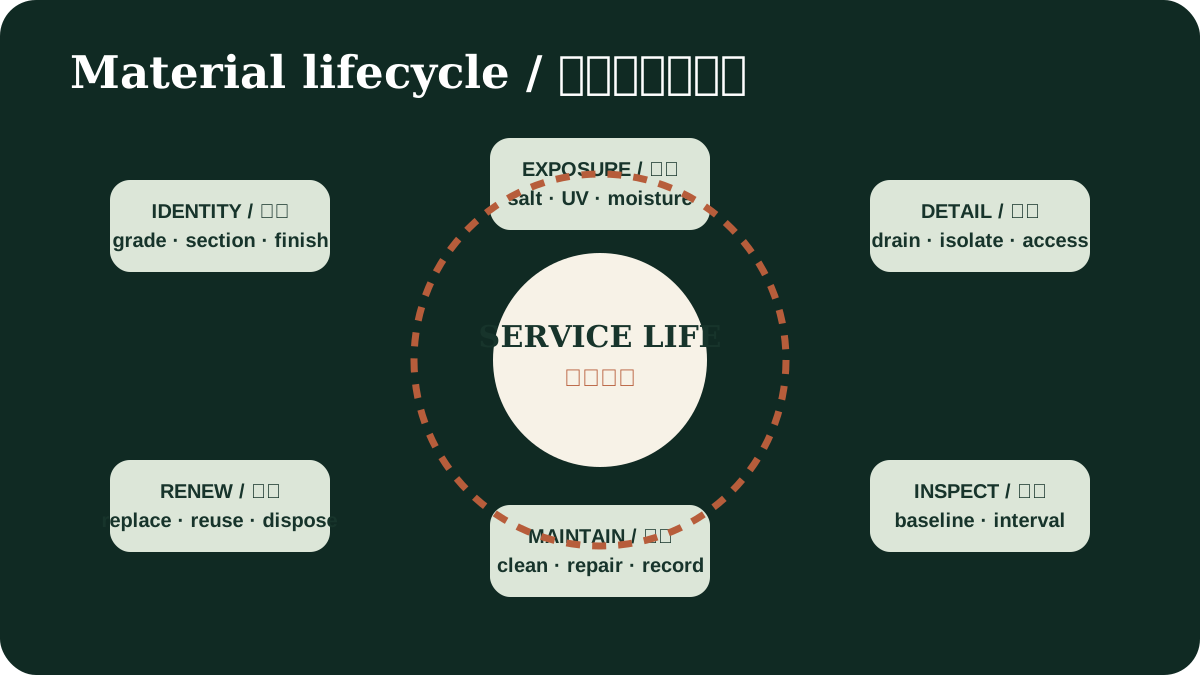
The circular sequence begins with verified material identity and environmental exposure, then passes through protective detailing, inspection and maintenance before renewal or replacement feeds back into the next cycle. The loop shows that durability depends on traceable specification, compatible connections, drainage and recorded care rather than the material name alone.
Key takeaways
- “Aluminum” is not one strength grade.View claim record ·
PWC-ALUMINUM-1 - Thin extrusions depend heavily on local buckling and connection details.View claim record ·
PWC-ALUMINUM-2 - Coastal exposure still requires material and finish planning.View claim record ·
PWC-ALUMINUM-3
The claim register connects stable IDs, article locations and article-level associated sources; it is not an external fact-check of each statement.
On this page
Design variables
Structural design uses the actual alloy, temper and section properties rather than appearance or nominal wall thickness alone. Welded heat-affected zones, screw-chase connections and concentrated forces can govern details.
Finish and interfaces
Powder coating or anodizing can protect appearance, but cut edges, trapped water and contact with dissimilar metals need attention. Isolating incompatible metals and providing drainage reduces corrosion risk.
Structural aluminum design reference cited by the International Building Code.
Ask for traceable material identity
A defensible submittal names the alloy and temper, extrusion drawing and revision, section properties used in calculation, surface treatment and any welded locations. Generic statements such as “aircraft-grade aluminum” do not establish yield strength, weld-zone properties, dimensional tolerance or structural suitability.
Thin-wall behavior and repair
Local dents, elongated screw holes and crushed internal webs can matter in thin extrusions even when the overall member appears straight. Repairs that add heat or new holes can change capacity and corrosion protection. Use the system designer’s repair procedure and preserve drain paths; do not hide damage beneath cover plates without assessment.
Official directory for aluminum standards, alloy data and errata.
Connect traceable material identity to design and durability
The extrusion drawing, alloy, temper, section properties and weld locations used in calculation should match supplied members. Equal outside dimensions are not enough because internal webs, corner radii and screw channels affect strength and connections. Link material records and extrusion revisions to member marks on project drawings. At installation, inspect cuts, fastener penetrations, weld zones and base interfaces separately from broad coated faces. Trapped residue, salt, dissimilar metals, damaged finish and unventilated crevices create local exposure that a general coating warranty may not describe.
Material traceability chain
Connect design properties to the installed extrusion.
| Checkpoint | Define | Retain |
|---|---|---|
| Identity | Alloy and temper | Material record |
| Geometry | Extrusion revision | Drawing/checks |
| Design | Section properties | Calculation schedule |
| Installation | Member mark/location | As-built evidence |
Evidence check before acting
This article provides general educational synthesis; these three checks turn reading into project-specific verification work.
| Confirm | Stronger evidence to retain | What this article cannot establish |
|---|---|---|
| Specified grade, finish system, exposure and compatible fasteners | Product traceability, mill or treatment records, finish data and project warranty terms | A generic material label does not establish grade, durability or suitability for the exposure. |
Registered cited sources and scope
Structural aluminum design reference cited by the International Building Code.
Official directory for aluminum standards, alloy data and errata.
European framework covering resistance, serviceability, durability and fire resistance of structural aluminium.
Official abstract for corrosivity categories affecting steel coating selection.
Cite this page
Pergola Wiki Editorial Team. “Aluminum pergola structures.” Pergola Wiki. Content version 1.7; editorially reviewed 25 Jul 2026. https://pergola.wiki/articles/aluminum/