Who created this, how it was made and why it exists
- Who
- Published under the organizational identity Pergola Wiki Editorial Team; neither AI nor the organization is presented as a named professional individual.
- How
- AI assistance was used for drafting, translation, source-metadata organization, static-site coding and automated QA in a publisher-directed workflow. Automated checks do not establish technical correctness.
- Why
- To provide free bilingual educational synthesis; one disclosed Oscar Pergola industry link does not determine conclusions, source tiers or rankings.
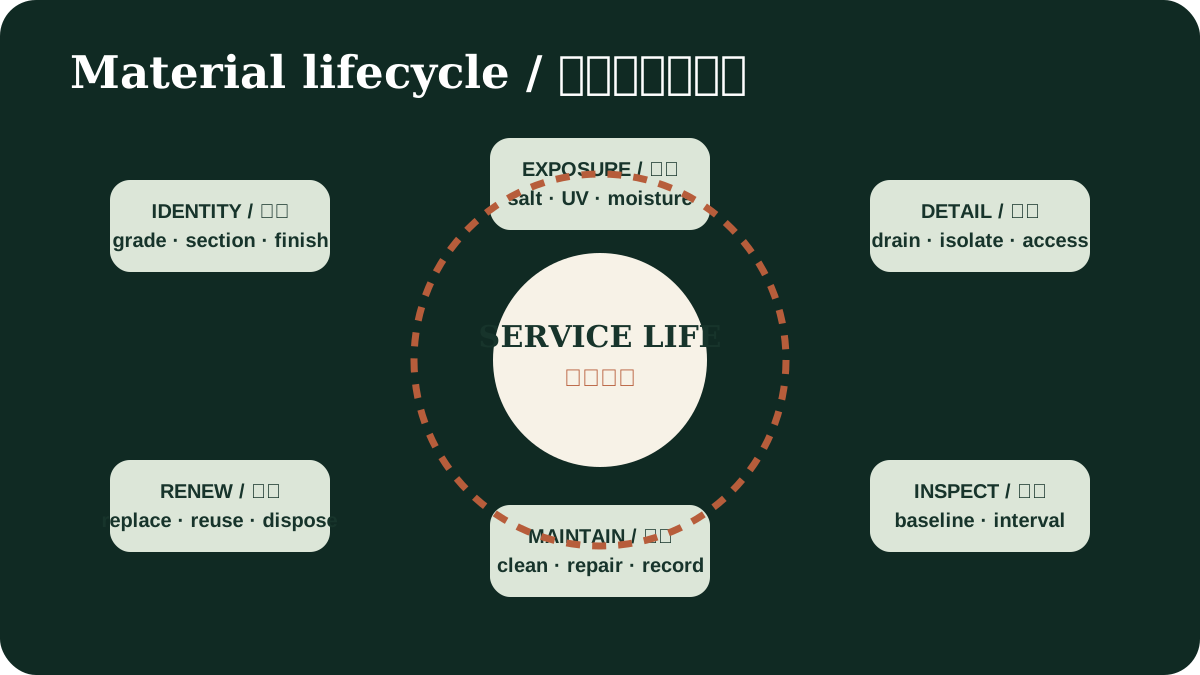
Read a detailed text description
The circular sequence begins with verified material identity and environmental exposure, then passes through protective detailing, inspection and maintenance before renewal or replacement feeds back into the next cycle. The loop shows that durability depends on traceable specification, compatible connections, drainage and recorded care rather than the material name alone.
Key takeaways
- Specify a complete corrosion-protection system.View claim record ·
PWC-STEEL-1 - Hollow sections need drainage or sealing strategy.View claim record ·
PWC-STEEL-2 - Coating durability is not the same as a warranty period.View claim record ·
PWC-STEEL-3
New or rewritten sections in this topic use section-mapped citations; the claim register remains editorial synthesis, not external fact-checking or independent review.
On this page
- Structure and fabrication
- Corrosive exposure
- Design the coating around details
- Distinguish staining from section loss
- “Galvanized” names a coating specification, not a fixed service life
- Fasteners and hardware carry their own coating standard
- Hollow sections need vent and drain paths, and that is a design decision
- Mixed metals: keep the interface dry or expect the anode to pay
- Steel does not burn, but fire performance is a separate check
- Steel pergola FAQ
Structure and fabrication
Steel can achieve slender frames, but member stability, weld quality, connection eccentricity and base-plate design still govern. Fabrication drawings should coordinate drainage holes, access for coating and site bolting.
Official Joint Research Centre directory page for the European steel-design Eurocode. It states that EN 1993 applies to the design of buildings and other civil engineering works in steel, that it complies with the principles and requirements for the safety and serviceability of structures, their basis of design and verification, given in EN 1990 — Basis of structural design, and that EN 1993 is concerned with requirements for resistance, serviceability, durability and fire resistance of steel structures. It states that EN 1993 is wider in scope than most other design Eurocodes and has about 20 parts covering common rules, fire design, bridges, buildings, tanks, silos, pipelines, piling, crane-supported structures, towers and masts and chimneys, and it lists the parts, including EN 1993-1-1:2005 (general rules and rules for buildings), EN 1993-1-2:2005 (general rules — structural fire design) and EN 1993-1-4:2006 (supplementary rules for stainless steels). It also states that EN 1993 is intended to be used in conjunction with EN 1990, EN 1991, product ENs, ETAGs and ETAs for steel structures, EN 1090 (execution of steel structures — technical requirements) and the other design Eurocodes. It is a European framework directory: it does not establish national adoption or a National Annex, a design value, a member capacity, a fire rating or a project approval, and it does not determine which edition applies to a project.
Corrosive exposure
ISO 12944 classifies environments to support coating selection for steel structures. Coastal, industrial and frequently wet locations can require more demanding systems and closer inspection than sheltered inland sites.
Official abstract for corrosivity categories affecting steel coating selection.
Design the coating around details
A coating specification should state preparation, primer, intermediate and finish system, dry-film thickness, edge treatment, repair method and the environmental exposure basis. Sharp edges, weld spatter, inaccessible crevices and water-retaining end caps can fail before broad flat surfaces even when the nominal coating system is suitable.
Official abstract for corrosivity categories affecting steel coating selection.
Official abstract establishing a lifecycle framework from briefing and design through maintenance, replacement, reuse and disposal.
Distinguish staining from section loss
Rust staining from a fastener is not the same as measurable loss of a post wall, but both require a source investigation. Clean enough area to see the origin, check hidden bases and drainage, and document pits or swelling. Simply painting over active corrosion obscures progression and can trap moisture.
Official abstract establishing a lifecycle framework from briefing and design through maintenance, replacement, reuse and disposal.
“Galvanized” names a coating specification, not a fixed service life
Hot-dip galvanizing is bought against a document, so start by identifying which one. ASTM A123/A123M-24 covers zinc coating applied by the hot-dip process to iron and steel products made from rolled, pressed and forged shapes, castings, plates, bars and strips, and it covers both unfabricated products and fabricated products such as assembled steel products, structural steel fabrications and large tubes already bent or welded before galvanizing. Its own scope marks where a general “galvanized” claim usually leaks: the specification does not apply to wire, pipe, tube or steel sheet galvanized on specialized or continuous lines, or to steel less than 22 gage (0.0299 in. [0.76 mm]) thick. Ask instead which standard, which coating class, which substrate thickness it was applied to, which preparation preceded it and which repair method is documented for cut edges, drilled holes and site damage. Two further limits matter on a pergola. First, the standard sets coating requirements for products in its scope; it is not a service life, and the exposure that decides how long a coating lasts is assessed separately — ISO 12944 already classifies environments for that purpose, and this article already treats the coating as a system rather than a label. Second, what is designed and what is delivered are connected by fabrication and execution: the Joint Research Centre states that EN 1993 is intended to be used in conjunction with EN 1090, Execution of steel structures — technical requirements, among other documents. A coating certificate for a batch of steel does not follow a member through cutting, welding, transport and site drilling unless those steps are controlled.
Public abstract and scope of the current ASTM specification for hot-dip galvanized zinc coatings. Its scope covers zinc coating by the hot-dip process on iron and steel products made from rolled, pressed and forged shapes, castings, plates, bars and strips, and it covers both unfabricated products and fabricated products such as assembled steel products, structural steel fabrications and large tubes already bent or welded before galvanizing. It states that it does not apply to wire, pipe, tube or steel sheet galvanized on specialized or continuous lines, or to steel less than 22 gage (0.0299 in. [0.76 mm]) thick, and that the galvanizing of hardware items to be centrifuged or otherwise handled to remove excess zinc — such as bolts and similar threaded fasteners, castings and rolled, pressed and forged items — shall be in accordance with Specification A153/A153M. It sets coating requirements for the products in its scope: it does not assign a steel grade, a structural capacity, a service life, an atmosphere corrosivity category or a project approval, and it states that its inch-pound and SI unit systems are not exact equivalents.
Official Joint Research Centre directory page for the European steel-design Eurocode. It states that EN 1993 applies to the design of buildings and other civil engineering works in steel, that it complies with the principles and requirements for the safety and serviceability of structures, their basis of design and verification, given in EN 1990 — Basis of structural design, and that EN 1993 is concerned with requirements for resistance, serviceability, durability and fire resistance of steel structures. It states that EN 1993 is wider in scope than most other design Eurocodes and has about 20 parts covering common rules, fire design, bridges, buildings, tanks, silos, pipelines, piling, crane-supported structures, towers and masts and chimneys, and it lists the parts, including EN 1993-1-1:2005 (general rules and rules for buildings), EN 1993-1-2:2005 (general rules — structural fire design) and EN 1993-1-4:2006 (supplementary rules for stainless steels). It also states that EN 1993 is intended to be used in conjunction with EN 1990, EN 1991, product ENs, ETAGs and ETAs for steel structures, EN 1090 (execution of steel structures — technical requirements) and the other design Eurocodes. It is a European framework directory: it does not establish national adoption or a National Annex, a design value, a member capacity, a fire rating or a project approval, and it does not determine which edition applies to a project.
Official abstract for corrosivity categories affecting steel coating selection.
Fasteners and hardware carry their own coating standard
The frame and the connection are not covered by one certificate. ASTM A123/A123M itself states that the galvanizing of hardware items to be centrifuged or otherwise handled to remove excess zinc — such as bolts and similar threaded fasteners, castings and rolled, pressed and forged items — shall be in accordance with Specification A153/A153M. That second standard covers hot-dip zinc coatings on iron and steel hardware, applies to items of Classes A, B, C and D, requires the coating thickness or weight/mass to conform to the values specified for those classes, and requires coated articles to be free from uncoated areas, blisters, flux deposits, dross inclusions and other defects, with a coating that is smooth and reasonably uniform in thickness. Read the practical consequence on a steel pergola: bolts, base plates, brackets, anchors and connectors each have their own coating document and class, and a frame supplied to A123 with fasteners bought on price, or a stainless member bolted through galvanized steel with a plain steel washer, is a mixed system whose least inspectable interface is at the joint. Put the coating standard and class for every hardware item in the submittal, not only for the sections, and record what happens when a fastener is replaced on site.
Public abstract and scope of the current ASTM specification for hot-dip galvanized zinc coatings. Its scope covers zinc coating by the hot-dip process on iron and steel products made from rolled, pressed and forged shapes, castings, plates, bars and strips, and it covers both unfabricated products and fabricated products such as assembled steel products, structural steel fabrications and large tubes already bent or welded before galvanizing. It states that it does not apply to wire, pipe, tube or steel sheet galvanized on specialized or continuous lines, or to steel less than 22 gage (0.0299 in. [0.76 mm]) thick, and that the galvanizing of hardware items to be centrifuged or otherwise handled to remove excess zinc — such as bolts and similar threaded fasteners, castings and rolled, pressed and forged items — shall be in accordance with Specification A153/A153M. It sets coating requirements for the products in its scope: it does not assign a steel grade, a structural capacity, a service life, an atmosphere corrosivity category or a project approval, and it states that its inch-pound and SI unit systems are not exact equivalents.
Public abstract of the current ASTM specification for hot-dip zinc coatings on iron and steel hardware. It states that the specification covers zinc coatings applied by the hot-dip process on iron and steel hardware, that the process forms layers of zinc/iron alloy adhering to the steel surface, that it applies to hardware items of Classes A, B, C and D, that the thickness or weight/mass of the zinc coating shall conform to specified values for the various classes of materials, and that coated articles shall be free from uncoated areas, blisters, flux deposits, dross inclusions and other defects, the coating being smooth and reasonably uniform in thickness. It also describes tests for minimum coating weight or thickness, finish and appearance, and embrittlement. It is a coating specification for hardware items: it does not set the substrate's grade, the connection design, the site exposure, a service life or a project approval.
Hollow sections need vent and drain paths, and that is a design decision
The Galvanizers Association explains the physical reason its detailing rules exist: articles to be galvanized are immersed into and withdrawn from a bath of molten zinc heated to about 450 °C, so design and fabrication must allow molten zinc to reach and drain from every surface. Its guidance records that holes provided for other purposes may satisfy venting and draining where they are adequate, and that extra holes may otherwise be needed; for hollow sections and internal compartments it states that galvanizing the internal surfaces eliminates the danger of hidden corrosion occurring in service; and it states that where a design includes sealed hollow sections, guidance on correct venting and drainage must be incorporated. The same page's fabrication notes say that external stiffeners, welded gussets and webs should have their corners cropped, with as large a gap as structural strength allows and a radius where welding runs around the edge. Three consequences follow. A closed post cap or a fully welded box with no vent is a corrosion detail, not a cosmetic one. Vent and drain holes are also a structural decision, because removing material, leaving an unsealed internal volume or creating a water and condensation path can change capacity and durability together. And the size, position, orientation and final closure of those openings belong in the project drawings, not in a workshop default. This is UK and Ireland industry process guidance; it sets no vent area, hole position or member capacity for a specific structure.
Technical guidance page from the Galvanizers Association, the hot-dip galvanizing industry association for the United Kingdom and Ireland. It explains that articles to be galvanized are immersed into and withdrawn from a bath of molten zinc heated to about 450 °C, that design and fabrication must therefore allow access and drainage of molten zinc, that holes present for other purposes may fulfil the venting and draining requirement where they are adequate and that extra holes may otherwise be necessary, that with hollow sections or internal compartments galvanizing the internal surfaces eliminates the danger of hidden corrosion occurring in service, and that where a design includes sealed hollow sections, guidance on correct venting and drainage must be incorporated. Its fabrication notes state that external stiffeners, welded gussets and webs should have their corners cropped, with as large a gap as structural strength allows and a radius where welding runs around the edge. It is industry process and detailing guidance: it does not set a vent or drain hole size, position or number, a member capacity, a coating class, a durability class or a project approval, and it is not a structural design code.
Mixed metals: keep the interface dry or expect the anode to pay
Steel frames are rarely one metal. A single pergola can combine galvanized or painted carbon steel members, stainless steel fasteners, aluminium roof members, zinc-plated brackets and a building interface of concrete, masonry or timber. The American Galvanizers Association explains the mechanism behind the risk: a bi-metallic couple behaves like a battery, with two dissimilar metals in an electrolyte and a conductive return path, and galvanic corrosion needs four elements — an anode, where corrosion occurs; a cathode, which is protected; an electrolyte carrying the current; and a metallic return current path. It states that all four are necessary, that removing any one stops the current flow, and that substituting a different metal can reverse the direction and move corrosion to the other electrode. Read that as a detailing instruction rather than a ranking of materials. What makes a joint aggressive is which metals are in contact, how often an electrolyte such as rain, splash, salt, irrigation or cleaning water bridges them, and how long it then stays there. So keep interfaces dry, drained and open to air where the design allows; use the documented isolation washer, coating or separation detail where water will persist; and never treat two “corrosion-resistant” descriptions as automatically compatible. This paragraph explains a mechanism from industry education material; it is not a corrosion rate, a coating or isolation specification, or a service-life prediction.
Industry association education page explaining the galvanic corrosion mechanism. It describes two primary types of galvanic cell — the bi-metallic couple, which it compares to a battery consisting of two dissimilar metals immersed in an electrolyte solution with an external conductive path, and the concentration cell, in which anode and cathode are the same metal or alloy and the driving force comes from a difference in concentration across the surfaces — and lists the four elements it states are necessary for corrosion to occur in a galvanic cell: an anode, where the galvanic reactions generate electrons and corrosion occurs; a cathode, which receives electrons and is protected from corrosion; an electrolyte, the conductor through which current is carried; and a return current path, the metallic pathway connecting anode to cathode, often the underlying metal substrate. It states that all four are necessary, that removing any one of them stops the current flow so that galvanic corrosion does not occur, that substituting a different metal for the anode or cathode may reverse the current and move the corrosion to the other electrode, and that the galvanic series lists metals and alloys in decreasing order of electrical activity. It explains a mechanism only: it gives no corrosion rate, no coating or isolation specification, no fastener rule, no service life and no project approval, and it is not a design code.
Steel does not burn, but fire performance is a separate check
“Steel is non-combustible”, true as a material property, is frequently offered as the whole fire answer. It is not. The Joint Research Centre describes EN 1993 as being concerned with requirements for resistance, serviceability, durability and fire resistance of steel structures, and lists structural fire design as its own part — EN 1993-1-2:2005 — beside the general rules and rules for buildings in EN 1993-1-1:2005 and the supplementary rules for stainless steels in EN 1993-1-4:2006. So whether a material adds fuel and how a member behaves at elevated temperature over a stated fire exposure, with or without protection, are different questions, answered by different documents. The site's wildfire and ember article already handles the exposure side for gardens in fire-prone areas. This section records only the boundary: “it will not burn” cannot stand in for a fire design, a separation distance, a local requirement, or a decision about protected or screened steel — those belong to the project and to the authority where the pergola is built.
Official Joint Research Centre directory page for the European steel-design Eurocode. It states that EN 1993 applies to the design of buildings and other civil engineering works in steel, that it complies with the principles and requirements for the safety and serviceability of structures, their basis of design and verification, given in EN 1990 — Basis of structural design, and that EN 1993 is concerned with requirements for resistance, serviceability, durability and fire resistance of steel structures. It states that EN 1993 is wider in scope than most other design Eurocodes and has about 20 parts covering common rules, fire design, bridges, buildings, tanks, silos, pipelines, piling, crane-supported structures, towers and masts and chimneys, and it lists the parts, including EN 1993-1-1:2005 (general rules and rules for buildings), EN 1993-1-2:2005 (general rules — structural fire design) and EN 1993-1-4:2006 (supplementary rules for stainless steels). It also states that EN 1993 is intended to be used in conjunction with EN 1990, EN 1991, product ENs, ETAGs and ETAs for steel structures, EN 1090 (execution of steel structures — technical requirements) and the other design Eurocodes. It is a European framework directory: it does not establish national adoption or a National Annex, a design value, a member capacity, a fire rating or a project approval, and it does not determine which edition applies to a project.
Steel pergola FAQ
Is galvanized steel rust-free for life? No. Galvanizing is a zinc coating specified to a document and a class; how long it lasts depends on the environment, the coating, cut edges, drainage, water and salt contact and inspection, and atmosphere corrosivity is assessed separately from the coating specification. Are bolts covered by the frame's galvanizing? Not by the same document — ASTM A123/A123M sends hardware such as bolts and similar threaded fasteners to A153/A153M, so fasteners and connectors carry their own standard and class. Is powder coating better than galvanizing? The label decides nothing; ask what is under the finish, how edges and cut ends are treated, whether the system is a duplex coating applied over galvanizing, and which repair method is documented. Can a hollow steel post be welded shut? Only with a documented venting and drainage plan, because the Galvanizers Association states that sealed hollow sections need correct venting and drainage and that galvanizing the internal surfaces is what removes the hidden-corrosion risk. Can steel and aluminium touch in one frame? They can be fixed together, and the question is the joint: galvanic corrosion needs an anode, a cathode, an electrolyte and a return current path, so keep the interface dry and drained and use the documented isolation or coating detail where water will sit. Is steel automatically the safer choice where fire matters? No — non-combustibility is not fire performance, and structural fire design is a separate part of the steel design framework plus a project-specific check under local rules. What should a steel pergola quotation state? At minimum the coating standard and class with the steel thickness it applies to, the coating standard for every bolt, bracket and anchor, the finish over the coating, the vent and drain details for hollow sections, the member grade and section, the connection and anchor schedule, the exposure assumption, and the inspection and repair method.
Public abstract and scope of the current ASTM specification for hot-dip galvanized zinc coatings. Its scope covers zinc coating by the hot-dip process on iron and steel products made from rolled, pressed and forged shapes, castings, plates, bars and strips, and it covers both unfabricated products and fabricated products such as assembled steel products, structural steel fabrications and large tubes already bent or welded before galvanizing. It states that it does not apply to wire, pipe, tube or steel sheet galvanized on specialized or continuous lines, or to steel less than 22 gage (0.0299 in. [0.76 mm]) thick, and that the galvanizing of hardware items to be centrifuged or otherwise handled to remove excess zinc — such as bolts and similar threaded fasteners, castings and rolled, pressed and forged items — shall be in accordance with Specification A153/A153M. It sets coating requirements for the products in its scope: it does not assign a steel grade, a structural capacity, a service life, an atmosphere corrosivity category or a project approval, and it states that its inch-pound and SI unit systems are not exact equivalents.
Public abstract of the current ASTM specification for hot-dip zinc coatings on iron and steel hardware. It states that the specification covers zinc coatings applied by the hot-dip process on iron and steel hardware, that the process forms layers of zinc/iron alloy adhering to the steel surface, that it applies to hardware items of Classes A, B, C and D, that the thickness or weight/mass of the zinc coating shall conform to specified values for the various classes of materials, and that coated articles shall be free from uncoated areas, blisters, flux deposits, dross inclusions and other defects, the coating being smooth and reasonably uniform in thickness. It also describes tests for minimum coating weight or thickness, finish and appearance, and embrittlement. It is a coating specification for hardware items: it does not set the substrate's grade, the connection design, the site exposure, a service life or a project approval.
Technical guidance page from the Galvanizers Association, the hot-dip galvanizing industry association for the United Kingdom and Ireland. It explains that articles to be galvanized are immersed into and withdrawn from a bath of molten zinc heated to about 450 °C, that design and fabrication must therefore allow access and drainage of molten zinc, that holes present for other purposes may fulfil the venting and draining requirement where they are adequate and that extra holes may otherwise be necessary, that with hollow sections or internal compartments galvanizing the internal surfaces eliminates the danger of hidden corrosion occurring in service, and that where a design includes sealed hollow sections, guidance on correct venting and drainage must be incorporated. Its fabrication notes state that external stiffeners, welded gussets and webs should have their corners cropped, with as large a gap as structural strength allows and a radius where welding runs around the edge. It is industry process and detailing guidance: it does not set a vent or drain hole size, position or number, a member capacity, a coating class, a durability class or a project approval, and it is not a structural design code.
Industry association education page explaining the galvanic corrosion mechanism. It describes two primary types of galvanic cell — the bi-metallic couple, which it compares to a battery consisting of two dissimilar metals immersed in an electrolyte solution with an external conductive path, and the concentration cell, in which anode and cathode are the same metal or alloy and the driving force comes from a difference in concentration across the surfaces — and lists the four elements it states are necessary for corrosion to occur in a galvanic cell: an anode, where the galvanic reactions generate electrons and corrosion occurs; a cathode, which receives electrons and is protected from corrosion; an electrolyte, the conductor through which current is carried; and a return current path, the metallic pathway connecting anode to cathode, often the underlying metal substrate. It states that all four are necessary, that removing any one of them stops the current flow so that galvanic corrosion does not occur, that substituting a different metal for the anode or cathode may reverse the current and move the corrosion to the other electrode, and that the galvanic series lists metals and alloys in decreasing order of electrical activity. It explains a mechanism only: it gives no corrosion rate, no coating or isolation specification, no fastener rule, no service life and no project approval, and it is not a design code.
Official Joint Research Centre directory page for the European steel-design Eurocode. It states that EN 1993 applies to the design of buildings and other civil engineering works in steel, that it complies with the principles and requirements for the safety and serviceability of structures, their basis of design and verification, given in EN 1990 — Basis of structural design, and that EN 1993 is concerned with requirements for resistance, serviceability, durability and fire resistance of steel structures. It states that EN 1993 is wider in scope than most other design Eurocodes and has about 20 parts covering common rules, fire design, bridges, buildings, tanks, silos, pipelines, piling, crane-supported structures, towers and masts and chimneys, and it lists the parts, including EN 1993-1-1:2005 (general rules and rules for buildings), EN 1993-1-2:2005 (general rules — structural fire design) and EN 1993-1-4:2006 (supplementary rules for stainless steels). It also states that EN 1993 is intended to be used in conjunction with EN 1990, EN 1991, product ENs, ETAGs and ETAs for steel structures, EN 1090 (execution of steel structures — technical requirements) and the other design Eurocodes. It is a European framework directory: it does not establish national adoption or a National Annex, a design value, a member capacity, a fire rating or a project approval, and it does not determine which edition applies to a project.
Official abstract for corrosivity categories affecting steel coating selection.
Galvanizing and mixed-metal check
Separate the coating document from the structure, and the fastener from the frame.
| Checkpoint | Define | Retain |
|---|---|---|
| Coating document | Standard, class and substrate thickness | Specification and inspection certificate |
| Hardware | Standard and class for every bolt, bracket and anchor | Hardware submittal |
| Hollow sections | Vent and drain path, size, position, closure | Shop drawing and photo record |
| Mixed-metal interfaces | Metals in contact, water and salt exposure | Isolation or coating detail |
| Repair and inspection | Method for cuts, drilled holes and damage | Inspection interval and record |
Evidence check before acting
This article provides general educational synthesis; these three checks turn reading into project-specific verification work.
| Confirm | Stronger evidence to retain | What this article cannot establish |
|---|---|---|
| Specified grade, finish system, exposure and compatible fasteners | Product traceability, mill or treatment records, finish data and project warranty terms | A generic material label does not establish grade, durability or suitability for the exposure. |
Registered cited sources and scope
Official abstract for corrosivity categories affecting steel coating selection.
European framework for actions including self-weight, imposed, snow and wind actions.
Official abstract establishing a lifecycle framework from briefing and design through maintenance, replacement, reuse and disposal.
Public abstract and scope of the current ASTM specification for hot-dip galvanized zinc coatings. Its scope covers zinc coating by the hot-dip process on iron and steel products made from rolled, pressed and forged shapes, castings, plates, bars and strips, and it covers both unfabricated products and fabricated products such as assembled steel products, structural steel fabrications and large tubes already bent or welded before galvanizing. It states that it does not apply to wire, pipe, tube or steel sheet galvanized on specialized or continuous lines, or to steel less than 22 gage (0.0299 in. [0.76 mm]) thick, and that the galvanizing of hardware items to be centrifuged or otherwise handled to remove excess zinc — such as bolts and similar threaded fasteners, castings and rolled, pressed and forged items — shall be in accordance with Specification A153/A153M. It sets coating requirements for the products in its scope: it does not assign a steel grade, a structural capacity, a service life, an atmosphere corrosivity category or a project approval, and it states that its inch-pound and SI unit systems are not exact equivalents.
Public abstract of the current ASTM specification for hot-dip zinc coatings on iron and steel hardware. It states that the specification covers zinc coatings applied by the hot-dip process on iron and steel hardware, that the process forms layers of zinc/iron alloy adhering to the steel surface, that it applies to hardware items of Classes A, B, C and D, that the thickness or weight/mass of the zinc coating shall conform to specified values for the various classes of materials, and that coated articles shall be free from uncoated areas, blisters, flux deposits, dross inclusions and other defects, the coating being smooth and reasonably uniform in thickness. It also describes tests for minimum coating weight or thickness, finish and appearance, and embrittlement. It is a coating specification for hardware items: it does not set the substrate's grade, the connection design, the site exposure, a service life or a project approval.
Official Joint Research Centre directory page for the European steel-design Eurocode. It states that EN 1993 applies to the design of buildings and other civil engineering works in steel, that it complies with the principles and requirements for the safety and serviceability of structures, their basis of design and verification, given in EN 1990 — Basis of structural design, and that EN 1993 is concerned with requirements for resistance, serviceability, durability and fire resistance of steel structures. It states that EN 1993 is wider in scope than most other design Eurocodes and has about 20 parts covering common rules, fire design, bridges, buildings, tanks, silos, pipelines, piling, crane-supported structures, towers and masts and chimneys, and it lists the parts, including EN 1993-1-1:2005 (general rules and rules for buildings), EN 1993-1-2:2005 (general rules — structural fire design) and EN 1993-1-4:2006 (supplementary rules for stainless steels). It also states that EN 1993 is intended to be used in conjunction with EN 1990, EN 1991, product ENs, ETAGs and ETAs for steel structures, EN 1090 (execution of steel structures — technical requirements) and the other design Eurocodes. It is a European framework directory: it does not establish national adoption or a National Annex, a design value, a member capacity, a fire rating or a project approval, and it does not determine which edition applies to a project.
Technical guidance page from the Galvanizers Association, the hot-dip galvanizing industry association for the United Kingdom and Ireland. It explains that articles to be galvanized are immersed into and withdrawn from a bath of molten zinc heated to about 450 °C, that design and fabrication must therefore allow access and drainage of molten zinc, that holes present for other purposes may fulfil the venting and draining requirement where they are adequate and that extra holes may otherwise be necessary, that with hollow sections or internal compartments galvanizing the internal surfaces eliminates the danger of hidden corrosion occurring in service, and that where a design includes sealed hollow sections, guidance on correct venting and drainage must be incorporated. Its fabrication notes state that external stiffeners, welded gussets and webs should have their corners cropped, with as large a gap as structural strength allows and a radius where welding runs around the edge. It is industry process and detailing guidance: it does not set a vent or drain hole size, position or number, a member capacity, a coating class, a durability class or a project approval, and it is not a structural design code.
Industry association education page explaining the galvanic corrosion mechanism. It describes two primary types of galvanic cell — the bi-metallic couple, which it compares to a battery consisting of two dissimilar metals immersed in an electrolyte solution with an external conductive path, and the concentration cell, in which anode and cathode are the same metal or alloy and the driving force comes from a difference in concentration across the surfaces — and lists the four elements it states are necessary for corrosion to occur in a galvanic cell: an anode, where the galvanic reactions generate electrons and corrosion occurs; a cathode, which receives electrons and is protected from corrosion; an electrolyte, the conductor through which current is carried; and a return current path, the metallic pathway connecting anode to cathode, often the underlying metal substrate. It states that all four are necessary, that removing any one of them stops the current flow so that galvanic corrosion does not occur, that substituting a different metal for the anode or cathode may reverse the current and move the corrosion to the other electrode, and that the galvanic series lists metals and alloys in decreasing order of electrical activity. It explains a mechanism only: it gives no corrosion rate, no coating or isolation specification, no fastener rule, no service life and no project approval, and it is not a design code.
Cite this page
Pergola Wiki Editorial Team. “Steel pergola structures.” Pergola Wiki. Content version 1.7.36; editorially reviewed 25 Sept 2026. https://pergola.wiki/articles/steel/