Who created this, how it was made and why it exists
- Who
- Published under the organizational identity Pergola Wiki Editorial Team; neither AI nor the organization is presented as a named professional individual.
- How
- AI assistance was used for drafting, translation, source-metadata organization, static-site coding and automated QA in a publisher-directed workflow. Automated checks do not establish technical correctness.
- Why
- To provide free bilingual educational synthesis; one disclosed Oscar Pergola industry link does not determine conclusions, source tiers or rankings.
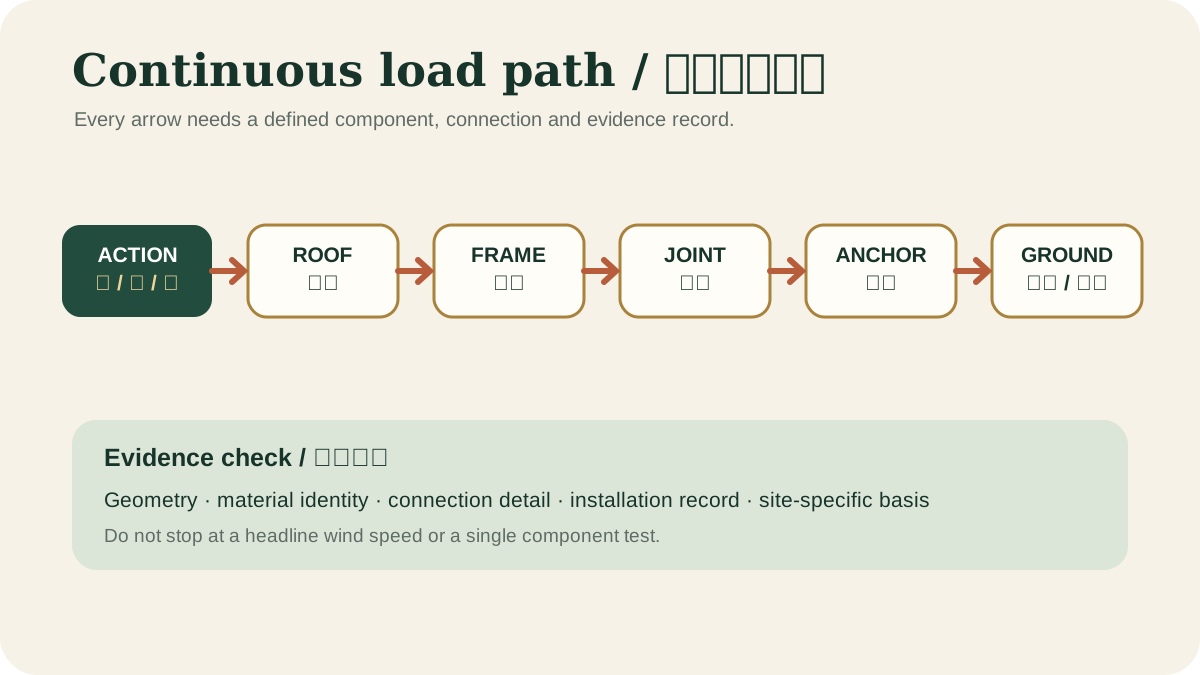
Read a detailed text description
The diagram follows gravity, wind uplift and lateral actions from the roof surface into rafters or louvers, beams and posts. It continues through every connection, base plate and anchor into the foundation and finally the supporting soil, emphasizing that one weak or undocumented link interrupts the claimed structural path.
Key takeaways
- Check load direction and eccentricity.View claim record ·
PWC-FASTENERS-CONNECTIONS-1 - Protect against incompatible-metal corrosion.View claim record ·
PWC-FASTENERS-CONNECTIONS-2 - Installation torque is not a universal design value.View claim record ·
PWC-FASTENERS-CONNECTIONS-3
The claim register connects stable IDs, article locations and article-level associated sources; it is not an external fact-check of each statement.
On this page
Connection behavior
Bolts, screws, welds and anchors transfer force through different mechanisms. Thin aluminum walls, timber end distance, steel plate bending and concrete breakout can each govern before the fastener itself fails.
Inspection
Connections should be visible or accessible where possible. Look for movement marks, loose hardware, split timber, cracked grout, coating damage and water traps, especially after severe weather.
Structural aluminum design reference cited by the International Building Code.
Connection capacity has multiple limit states
A bolt or screw can be strong while the connected sheet tears, bearing deforms, a thin wall crushes, an edge splits or the substrate pulls out. Design and review therefore need the complete joint geometry, material thickness, hole type, edge distances, slip expectations and installation method—not only fastener diameter.
Inspection requires a defined method
Torque is not a universal proxy for clamp force, especially with self-drilling screws, polymer washers or slotted holes. State which connections receive torque verification, witness marks or visual checks and when they are rechecked. Repeated loosening signals movement or joint design issues; adding thread-locker without diagnosing the cause can hide the warning.
Government technical reference on wood properties, moisture, decay, fasteners and design.
Evidence check before acting
This article provides general educational synthesis; these three checks turn reading into project-specific verification work.
| Confirm | Stronger evidence to retain | What this article cannot establish |
|---|---|---|
| Site actions, continuous load path, foundations, connections and supporting structure | Project-specific site data, calculations, approved drawings and inspection records | A general table, calculator or article is not a project design or approval. |
Registered cited sources and scope
Structural aluminum design reference cited by the International Building Code.
Government technical reference on wood properties, moisture, decay, fasteners and design.
ANSI-approved wood design standard referenced by 2024 US model codes.
Official standard hub for US structural actions including wind, snow, rain, seismic and load combinations.
Cite this page
Pergola Wiki Editorial Team. “Fasteners and structural connections.” Pergola Wiki. Content version 1.7; editorially reviewed 25 Jul 2026. https://pergola.wiki/articles/fasteners-connections/